
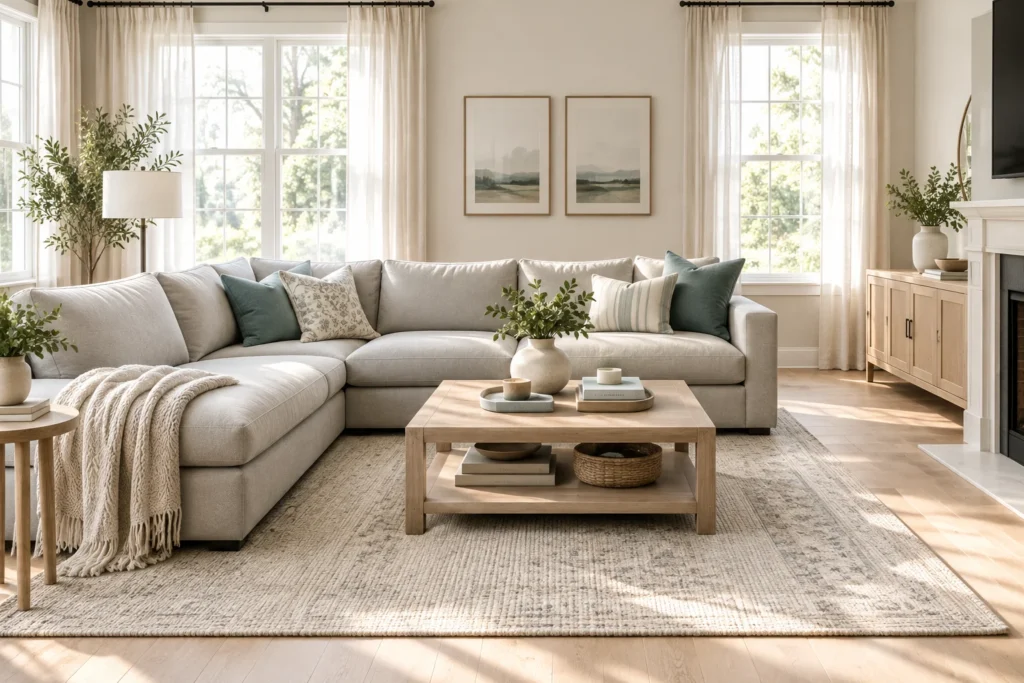

What Images of Living Rooms with Sectionals Reveal About Flow and Space
I keep seeing the same mistake in homes I own: someone buys a big comfortable sectional for the extra seating and then pushes every piece of living room furniture against the walls. The room still feels tight.
Images of living rooms with sectionals show a better way. I use these images to see how a sectional anchors a living room and defines traffic flow instead of just adding seats.
A sectional can float in the middle of a living room and create two zones without a single wall. Floating placement keeps the walkway open on both sides while still giving each zone its own defined edge.
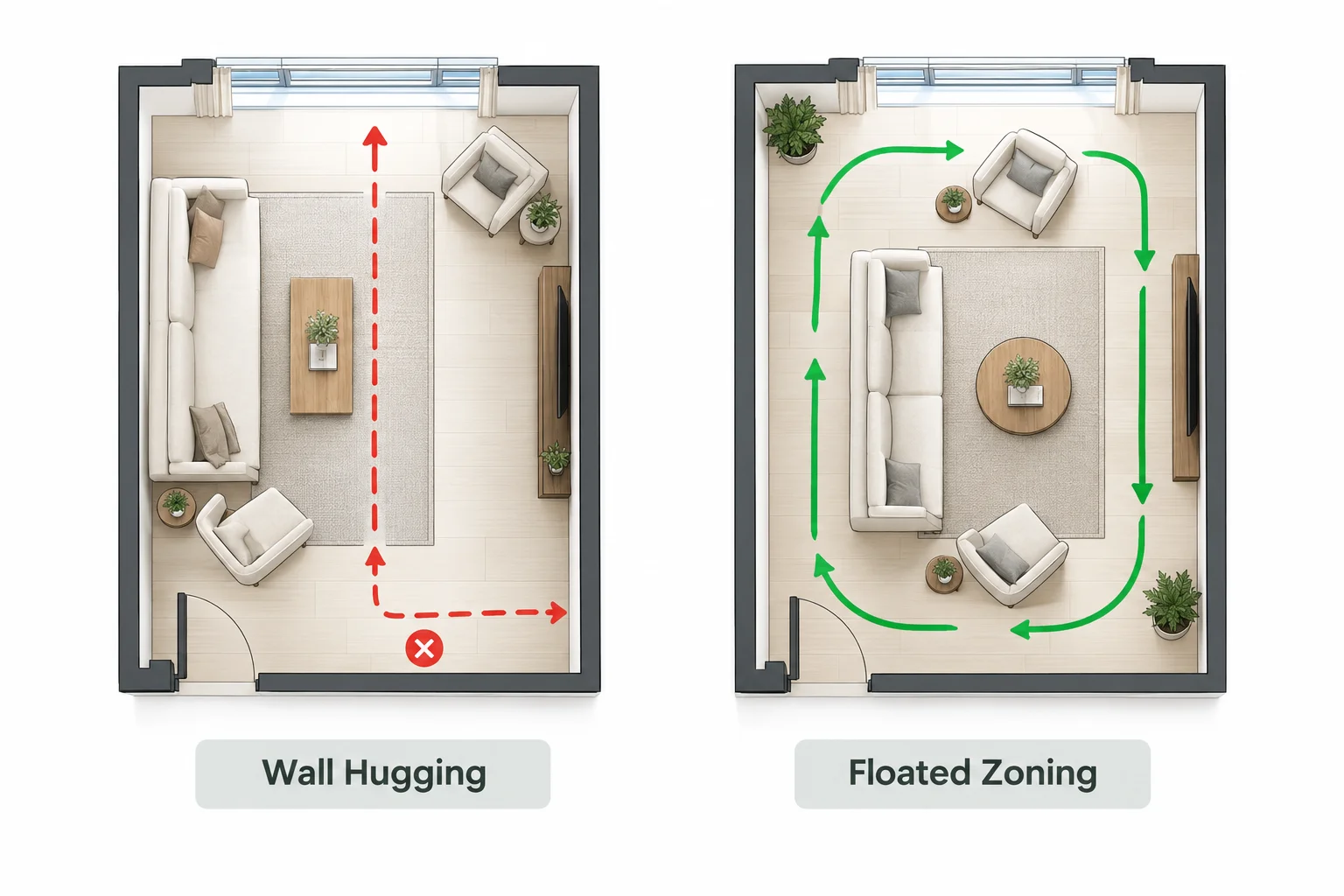
I learned this the hard way in a narrow room I helped with. The sectional sat flat on the longest wall and blocked the walkway to the kitchen. I pulled it a few feet out and turned the back toward the dining area. Traffic Flow opened right away. And the seating capacity felt larger even though I added nothing.
In interior design, the sectional sets the focal line for the whole room; it points the eye toward natural light or the main wall and tells the rest of the furniture where to sit. Pulling it even a few inches off the wall and angling the back toward the next room fixes most layouts instantly.
Pulling the sectional even a few inches off the wall and angling the back toward the next room solved it instantly; no new furniture needed.
Table of Contents
15 Images of Living Rooms with Sectional Sofas That Actually Fit Real Homes
I know you came for pictures that look like your home. Not a showroom fantasy. I pulled 15 images of living rooms with sectional sofas that match the rooms. I see it every day in apartments and family homes. You can spot your layout fast without scrolling through mansions.
I grouped the images by the problem you are solving. Not by random color. That saves time. You can jump straight to what you need and see how the sectional actually sits in that space.
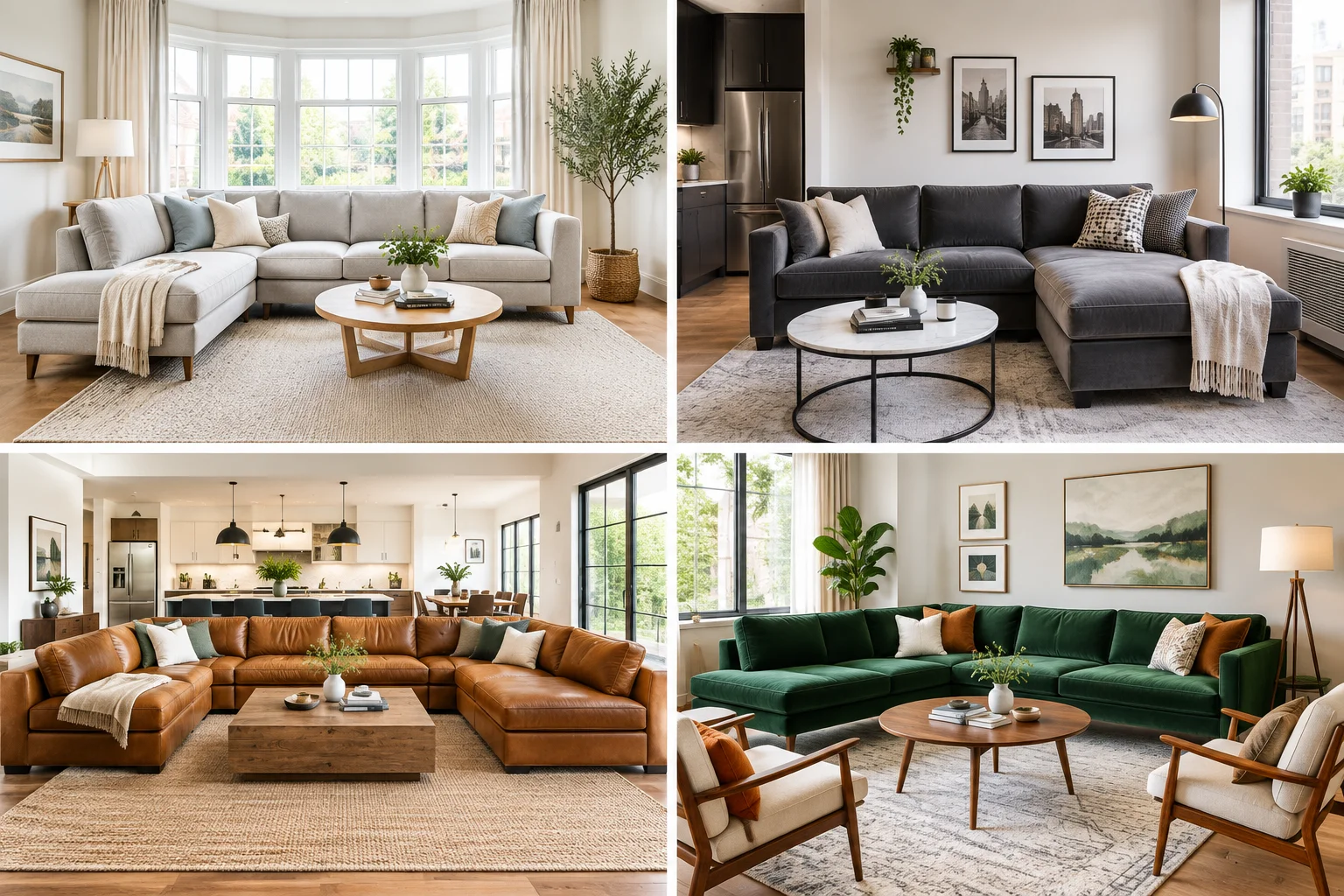
Small Apartment Winners
Small Apartment Winners is where I started because this is where most people feel stuck. I picked a light grey sectional living room with an L shaped sectional tucked into a corner by a bay window. The light grey brightens a compact room instantly. I learn that from putting the same charcoal tone in a tiny room and watching it feel heavy.
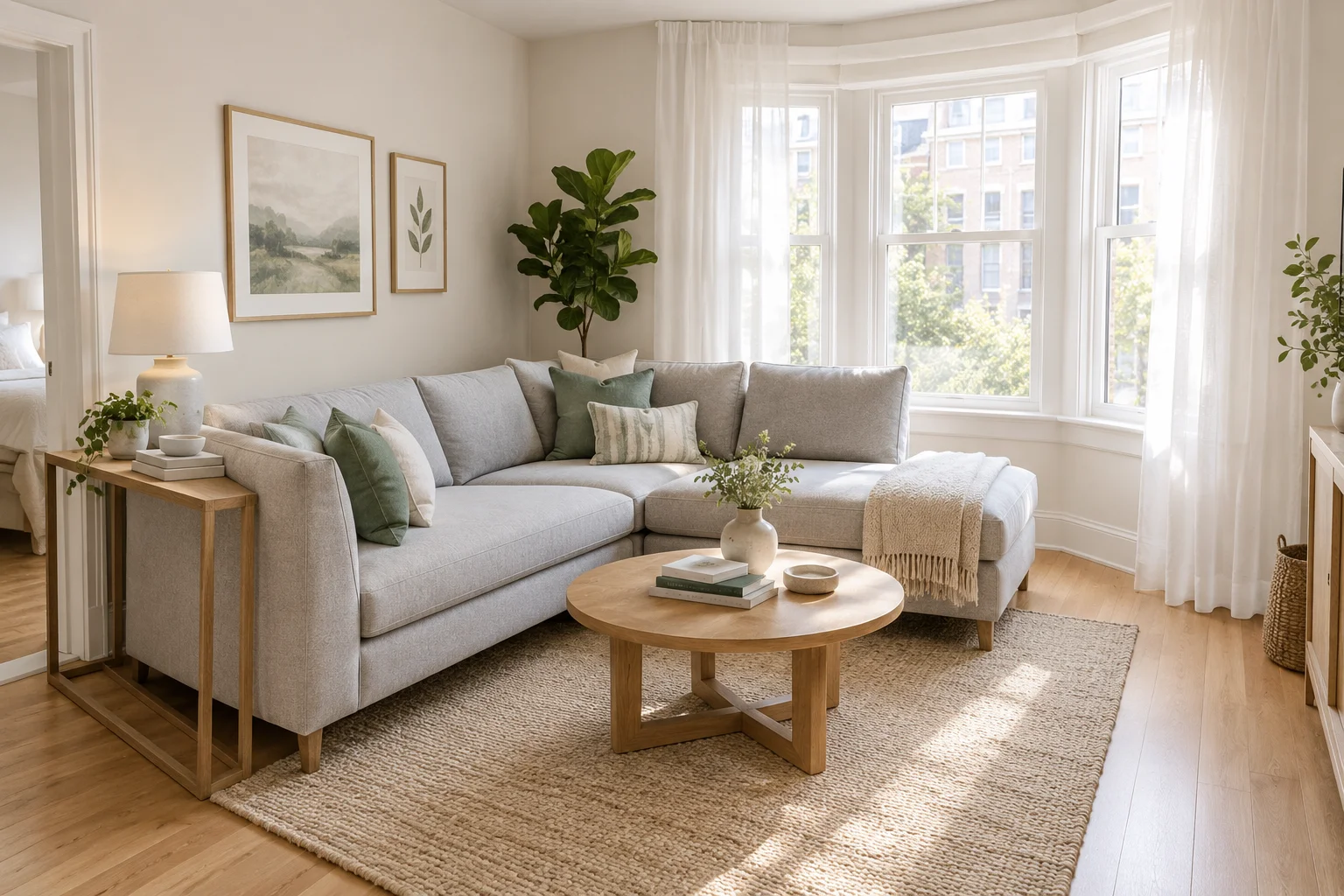
I also kept a charcoal grey velvet sectional couch with a chaise in a tight apartment. The chaise keeps the footprint light while the velvet adds comfort. You can see a narrow console table behind the sofa and a small round coffee table in front. Which is the whole trick for tight spaces.
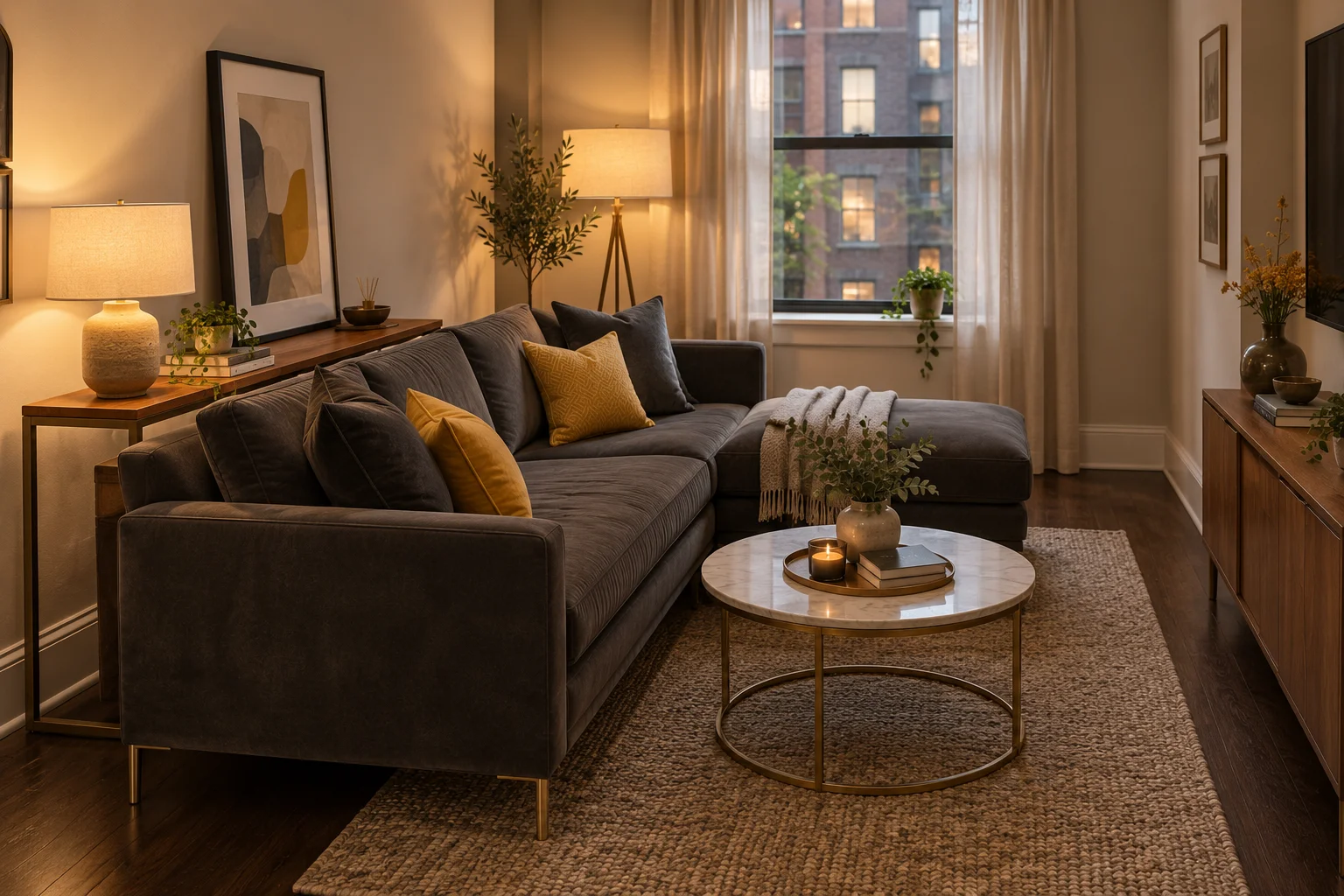
A beige sectional sofa in soft linen shows up twice in this set. One sits low near a bow window with exposed legs that leave the floor visible. And that makes the room feel larger than it is. The other is a reversible navy chaise that fits a narrow wall without blocking the walkway. Both prove a sectional couch can work in a small living room when I choose raised legs and a light neutral.

Large and Open Concept Showpieces
For larger homes I wanted to show weight without crowding. A U shaped sectional in saddle leather anchors an open concept living room on a big area rug. The U shaped sectional in light ash grey faces a centered fireplace and balances with tall art on the wall. Light grey keeps the large room calm. Charcoal would add drama, but it can close the space in.

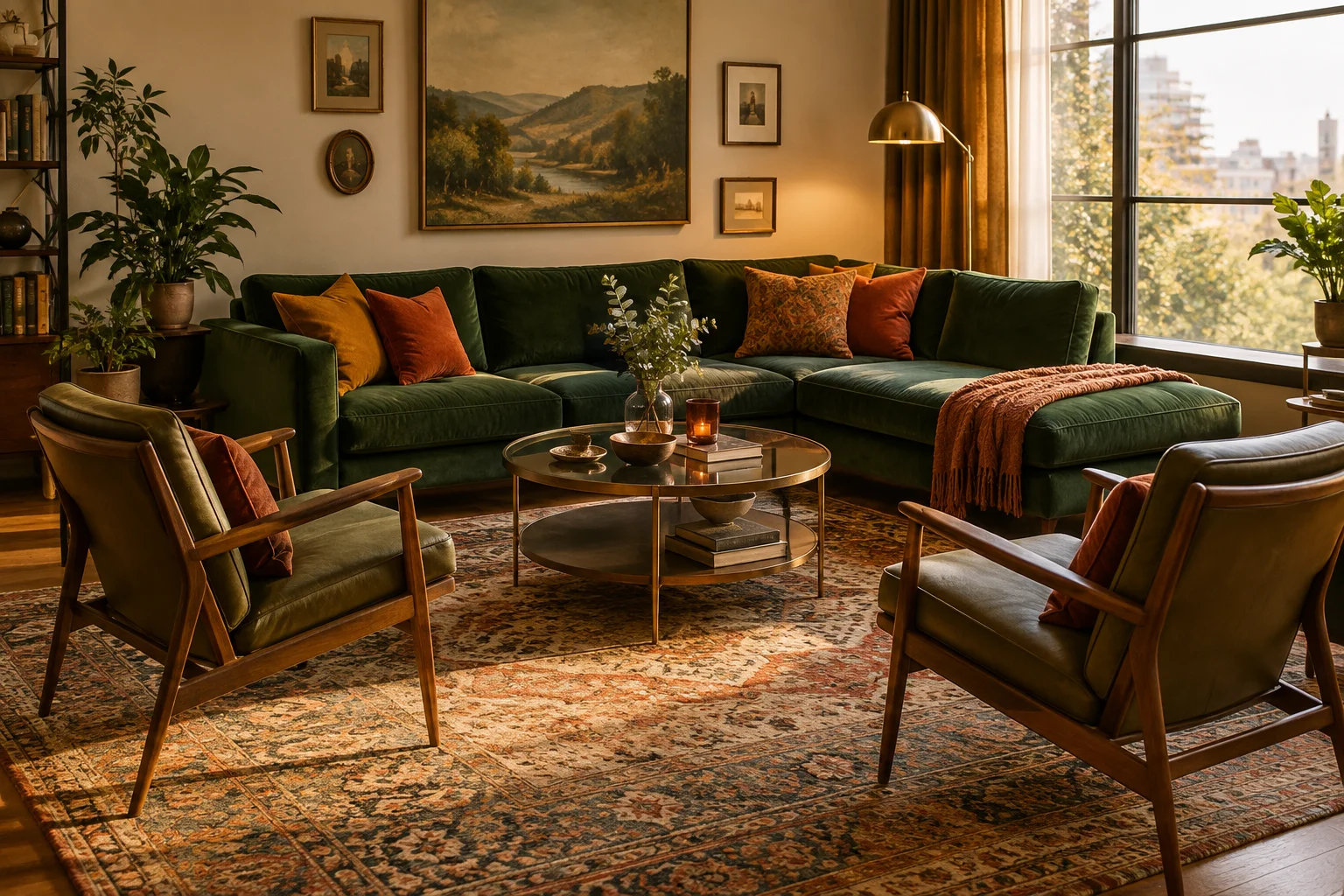
Every image here shows companion pieces doing real work. A forest green velvet L shaped sectional with two mid century chairs opposite the chaise creates a balanced conversation zone. A modular cream sectional divides living and dining without a wall. A curved ivory boucle around a round coffee table becomes the focal point, and an ottoman grounds the family lounge. I chose these because they show how the sectional lives with other furniture. Not alone.
The Small Room Myth: Why Sectionals Can Make Tiny Living Rooms Feel Bigger
I hear the same worry every time someone messages me about a small living room. They think a sectional will swallow the room. I get why they think that. A sectional can actually make a small living room feel bigger than a couch plus loveseat plus chair. One clean footprint uses the dead corner and leaves more open floor.
“I lived with a sectional in a 10×12 apartment living room for two years. The lesson was fast: a bulky arm or a low chaise that didn’t tuck under a window wasted more floor than the sofa itself. I look at sectional sofa ideas for small living rooms through that lens of function before style.
Start With How You Live, Not Just How It Looks
Before I look at any section, I ask how the room really gets used. Do you entertain often? Do you chill with a dog and watch shows? Is the room for kids, or is it an adults only retreat? Which is the whole point.
Your answer decides the seating you need. Not a catalog photo. And that choice keeps you from buying a big piece that never fits how you live.
Choosing the Right Size and Shape for Compact Spaces
This is the first thing I check. Room dimensions tell me what will fit without crowding the walkway. I look for a corner sectional or a sectional with a chaise that shows more floor. Exposed legs with turned wood or a slender raised base let me see the floor underneath. And that visual transparency makes the room feel larger.
I also look for extra storage where I can. A chaise lounge with hidden storage inside helps in tight homes. I pair that with tall, narrow ladder shelves that use wall height instead of floor space. The right size is usually simple or at least simpler than it looks at first.
I pick soft neutrals with cohesive tones for small spaces. A neutral sofa with tufting or fluting or gentle curves adds character without overwhelming a small living room. Which most guides skip completely, and that is a mistake.
Push Against the Wall or Float It
Every small room needs a clear walkway. I keep that path open no matter what. In a narrow small living room, I push the corner sectional into the corner to keep the center open. In a square room with two doors, I float the sectional a little off the wall so traffic can move around it.
The exposed legs keep the float from feeling heavy. Not always. But most of the time that slight float feels more open than shoving everything flat against the walls.
How to Arrange a Sectional Sofa in a Living Room Without Blocking Flow
I see the same layout fail in almost every living room I walk into. The sectional sits flush against the walls, and the main walkway disappears. I arrange a sectional by keeping traffic flow open first and then placing the sofa where the focal point lives.
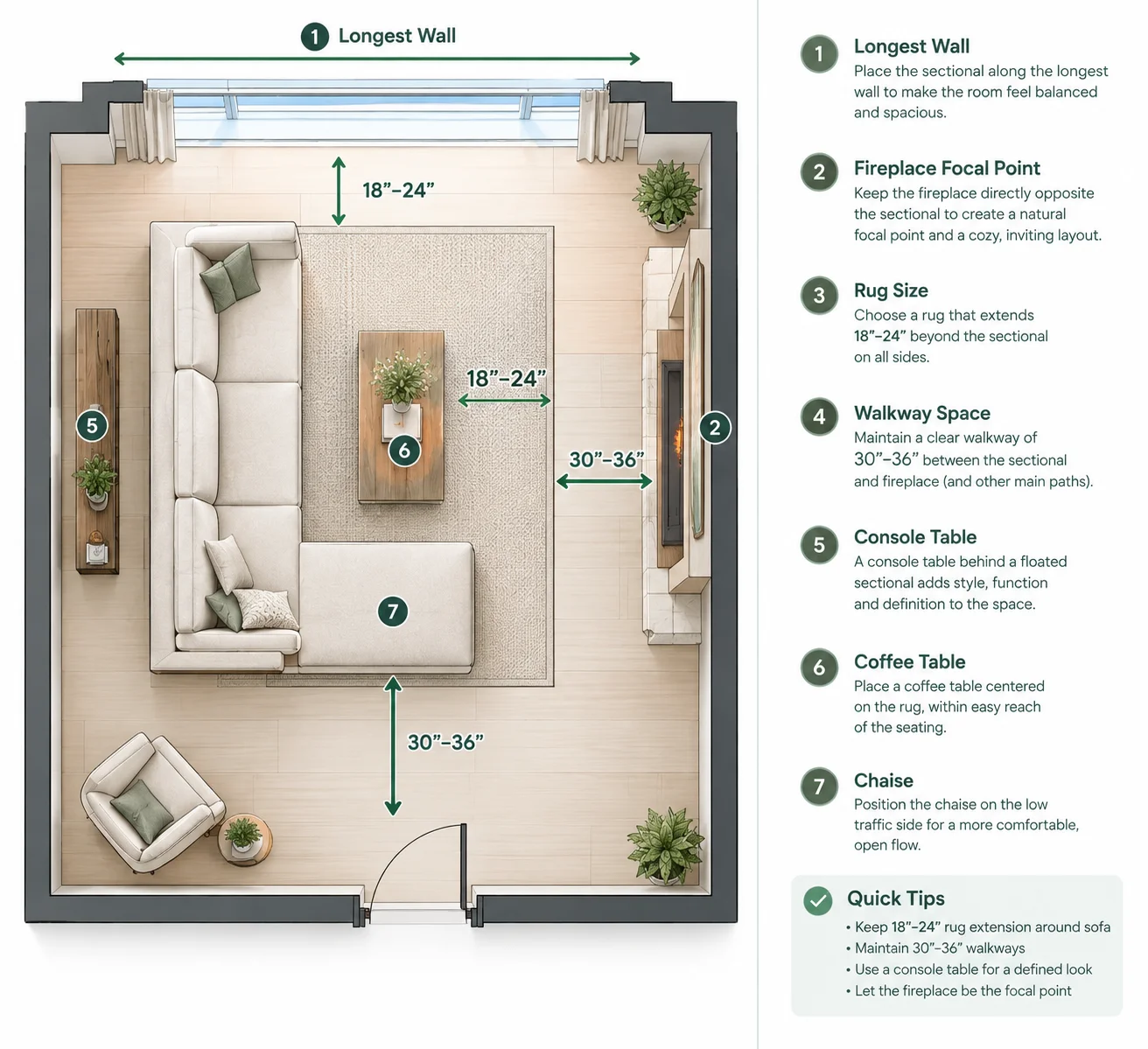
When people ask me how to arrange sectional sofa in living room without blocking flow, I give them five checks. I measure the room and the doorways. I pick the focal point like a fireplace, TV wall, or big window. I sketch a quick floor plan before I move anything heavy. I put the long side on the longest wall. I anchor the group with a rug that reaches 18 to 24 inches past the edges with front legs on the rug. I keep a 30- to 36 inch walkway and put the chaise lounge on the low traffic side. Which is the step most people skip.
| Step | What to Check | Target |
|---|---|---|
| 1. Measure | Room + doorway widths | Note the tightest point first. |
| 2. Focal point | Fireplace, TV wall, or window | The long side faces it. |
| 3. Rug size | Past sofa edges | 18–24 in overhang, front legs on rug |
| 4. Walkway | Main traffic path | 30–36 in clear |
| 5. Chaise side | Low-traffic zone only | Never across the walkway |
The L Shaped Layout Your Most Versatile Starting Point
The L shaped sectional living room layout is the one I use most. I line the L shaped sectional along two walls and keep the center open while the return arm defines the area. In a medium living room I turn the sectional perpendicular to the focal point so it faces the fireplace or TV wall. And this is exactly where things go wrong when people buy by wall length alone.
When a U Shaped or Modular Sectional Makes Sense
A U shaped sectional belongs in a large family room where conversation should stay inside. I center the U shaped sectional across from the focal point and let the wings face each other. I balance the weight with tall art or a bookcase. A modular sectional solves tight access. I use a modular sectional for rooms with stairs or angled walls or narrow halls because I can move the pieces in parts. That flexibility saves a lot of trouble on delivery day.

| Sectional Shape | Best Room Size | Ideal Placement | Walkway Needed |
|---|---|---|---|
| L-Shaped | Small–Medium | Corner, perpendicular to focal point | 30–36 in |
| U-Shaped | Large | Centered, facing focal point | 36+ in |
| Modular | Any (flexible access) | Split for stairs/angled walls | 30–36 in |
| Chaise-only | Small/Narrow | Low-traffic side, floated, or corner | 30–36 in |
Floating Mid Room to Create Zones in Open Plans With Console Trick
In an open plan I often float the sectional away from the walls. I pull the sectional forward and use the back as a divider between living and dining. I ground the back with a narrow console table and a pair of lamps.
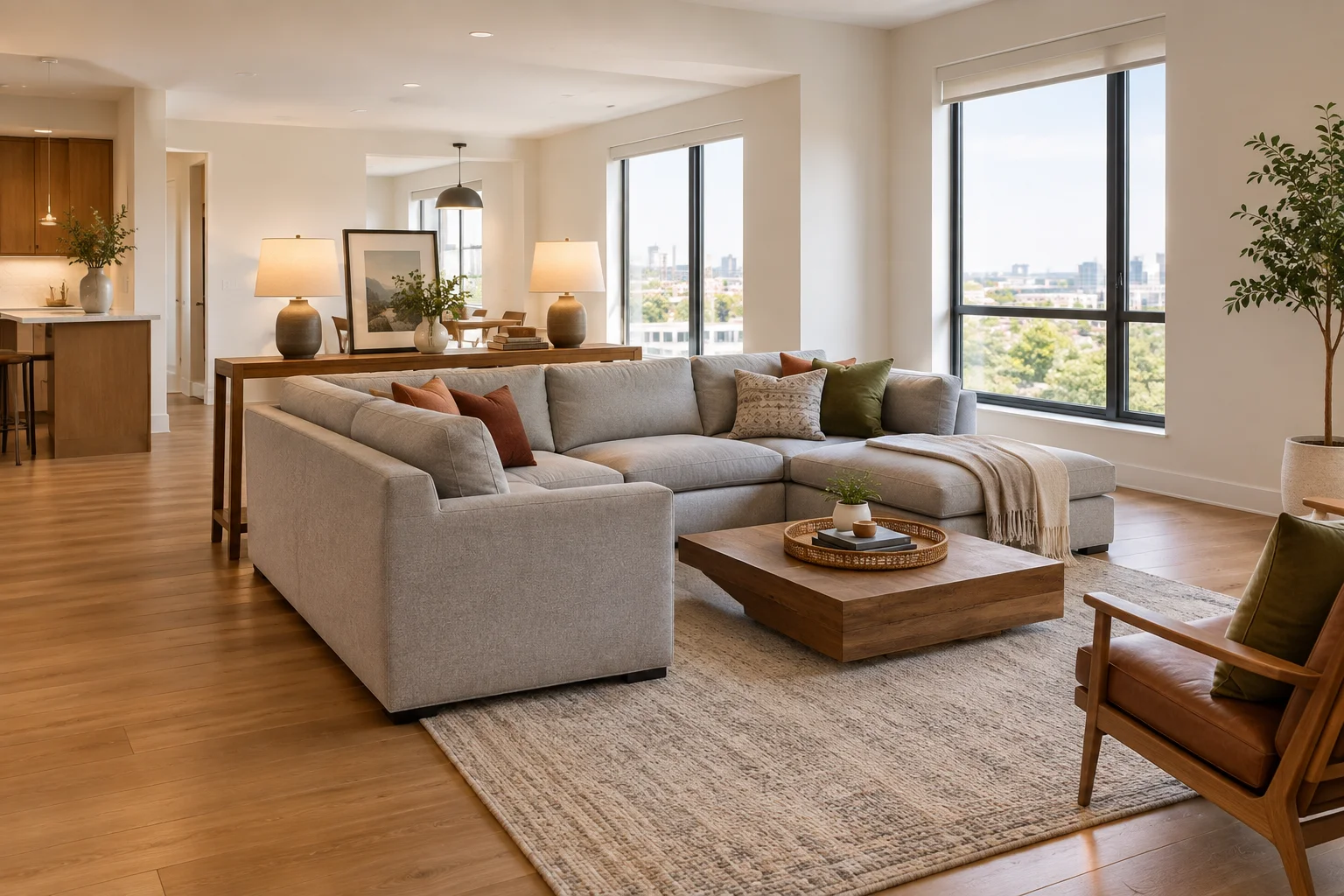
I fixed an awkward living room with three doors and a kitchen peninsula cutting through the seating. I shifted the group to protect a 36 inch walkway. I swapped a heavy loveseat for two swivel chairs with drink tables. And I chose a chaise over a full L shaped sectional because the chaise blocked less traffic. The room finally breathed.
Living Room Ideas with Sectional and Fireplace: Keep the Hearth Visible
I see a lot of living rooms where the sectional crowds the fireplace and the hearth disappears behind cushions. I never place the long edge of the sectional directly in front of the fireplace. I turn the sectional so the long edge sits perpendicular to the fireplace. That keeps the hearth visible and the conversation facing inward.

A fireplace is the natural focal point of the room. When I put the sectional perpendicular to that focal point, I let the fireplace stay the star. The seating then anchors around a shared area rug and a coffee table.

I center the sectional across from the fireplace when the room is wide enough. In a narrow room I slide the sectional to the side and keep the return arm pointing away from the hearth. Both ways leave a clear path to the fireplace. And that path matters more than it looks.
I make sure at least the front legs of the sectional sit on the area rug. That sectional and rug pairing ties the seating to the fireplace instead of floating apart.
This anchor works in most living rooms with a fireplace, though a very shallow hearth wall may need the sectional pulled further back to clear heat clearance. The fix is usually simple or at least simpler than people expect.
What Nobody Tells You About Sectionals and Bay Windows
I love the light a bay window brings, and I cringe when I see a tall sectional blocking it. You can absolutely put a sectional by a bay window or a bow window. I do it often. I just keep the sectional placement low and intentional.
A bay window sill sets the height limit. I measure from floor to sill before I shop. I pick a low profile sectional that sits below that line so natural light pours over the back. I also leave a clear gap between the window trim and the sofa back. That gap lets me open curtains and lets light spill into the room.
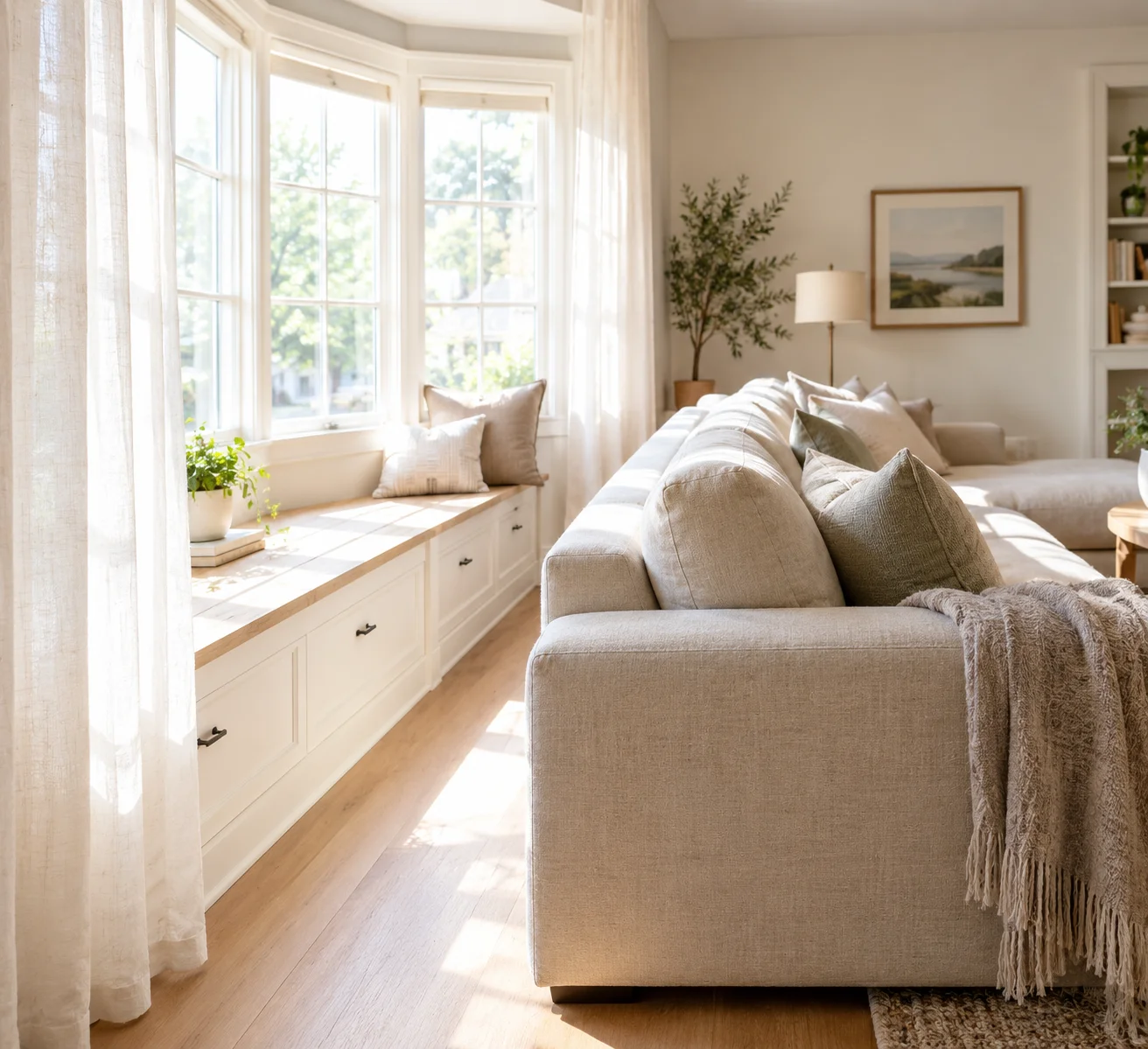
That gap also gives me a chance to save floor space. I use built in storage inside the bay window itself. A bench with lids tucks right into the bay and holds blankets without stealing the living room floor. I saw this work beautifully in a small living and dining room where large windows and that bench made the whole space feel expansive.
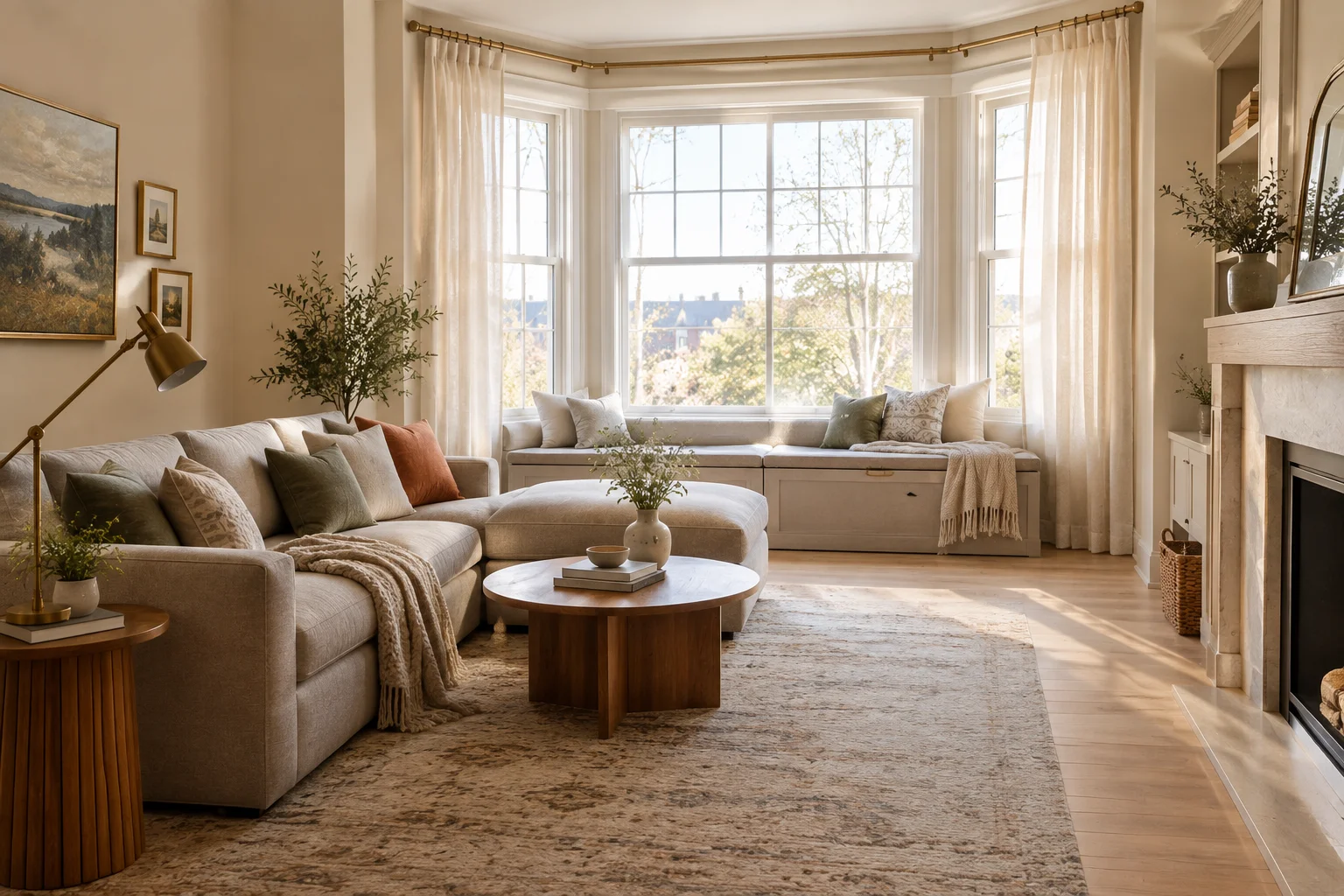
Every time I see a high back sectional jammed tight to a low sill, the room goes dark. Not always. But most of the time the fix is simple. A low sectional that respects the sill and a small breathing gap keeps natural light moving, and the sectional placement feels intentional rather than crowded. The fix is usually simple or at least simpler than people expect.
Living Room with Sectional and Chairs: The Balancing Act
I see a lot of rooms where a solid sectional gets paired with another solid loveseat. The room instantly feels heavy. I balance a sectional with one or two light accent chairs placed opposite the chaise. That keeps the weight even.
A sectional is a solid block. I need air on the other side. I choose accent chairs with exposed wood or metal legs that let me see the floor underneath. I angle the chairs slightly inward toward the coffee table so the conversation stays inside the group.
Which is the whole point of a seating zone.
In a real room I fixed, I pulled out a heavy matching loveseat and replaced it with two swivel chairs and small drink tables. The swivel lets people turn toward the conversation or the TV. And that flexibility matters in daily life.
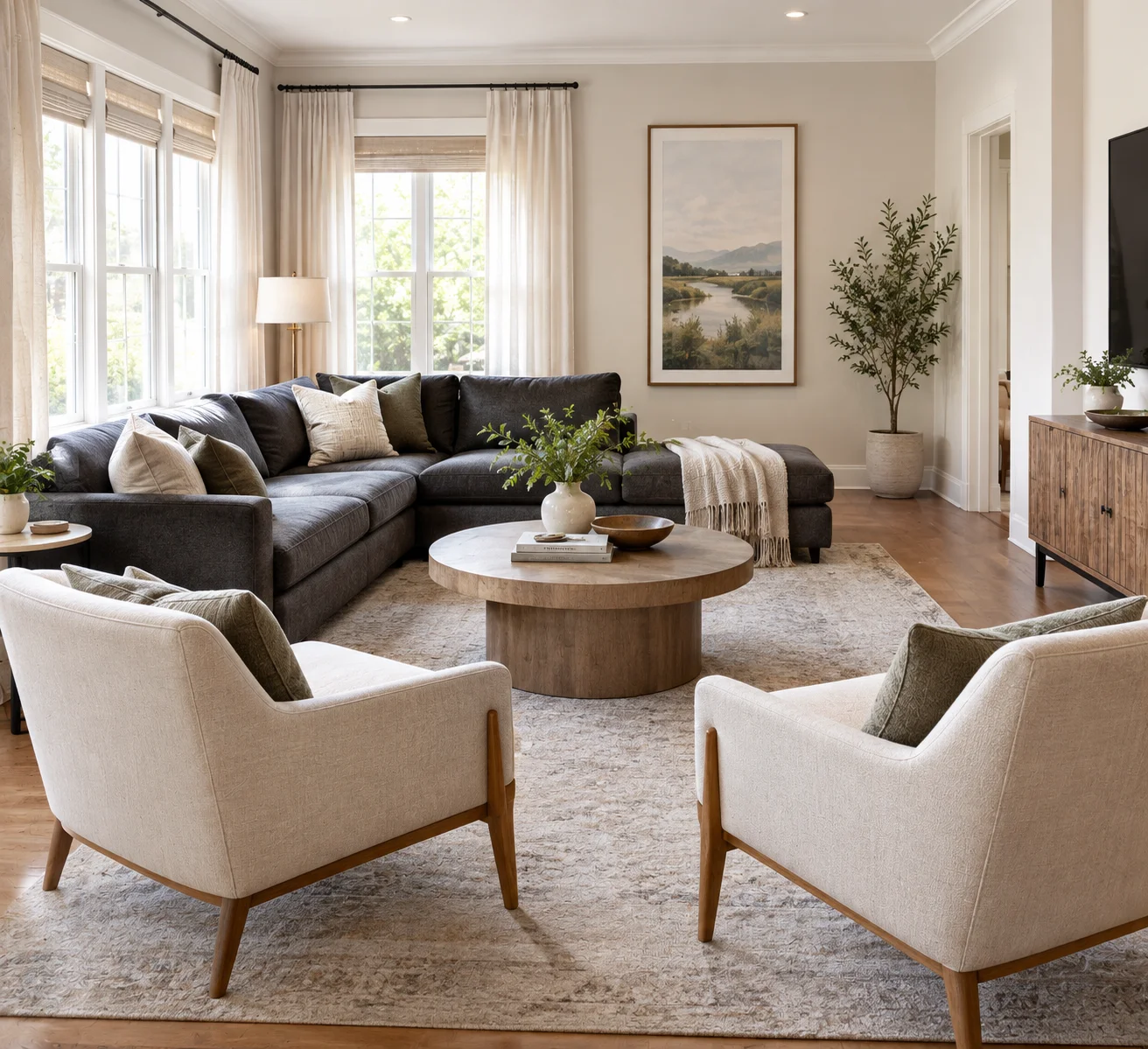
For a heavy U shaped sectional, I add vertical lift as well. I hang tall art or place a bookcase near the seating so the eye moves up. That keeps the low, heavy sofa from squatting in the room. These are the same checks I run before recommending a sectional to a client: measure first, style second. The fix is usually simple or at least simpler than people expect.
Colors and Fabrics That Survive Real Life
I made the mistake of putting a soft velvet sectional in a busy family room once. It looked great for a month. Then it showed every mark. I now pick upholstery by how I live, not just how it looks in a photo.

If you want fabric that survives real life I lean toward performance fabric or a leather sectional for daily use. A fabric sectional in velvet stays beautiful in a formal room where it gets less traffic.
Grey Beige or Bold Leather: What Holds Up Best
A grey sectional living room is the safest color scheme I know for a first-time sectional buyer. Grey works as a neutral that bridges modern and traditional living room decor. Light grey brightens a compact room instantly. Charcoal grey adds drama and weight in a large room. I pair grey with beige or cream or warm white to keep it calm. I add teal or burnt red to keep it from feeling flat. Patterned textiles do the same work. A subtle pattern on cushions or a textured rug adds depth so the grey does not feel sterile.
A beige sectional sofa does similar work but feels warmer. I use beige when I want a soft Scandinavian feel. I keep the color palette light and let wood tones add warmth. Bold leather in cognac or saddle brown brings warmth and ages well; it’s also the look I reach for in farmhouse-style living rooms with sectionals, where a worn leather tone fits the room better than a crisp fabric one. I use leather when the room gets daily use from kids or pets too.

Performance Fabric vs Velvet vs Microfiber at a Glance
This is the quick way I think about home decor fabrics. Performance linen handles bright light and high traffic and needs only spot cleaning. Leather handles family life and pets and needs just a wipe. Textured velvet looks rich in a formal space but needs gentle brushing. Woven microfiber gives everyday lounging on a budget and resists stains.
. The fix is usually simple or at least simpler than people expect.
Stop Doing This: 4 Layout Mistakes That Ruin a Sectional
I walk into living rooms and see the same four mistakes with sectional placement. They make the room feel cramped or off balance even when the furniture is nice. I fix traffic flow first because that one mistake ruins everything else.
Mistake one is pushing the sectional flush against the walls. That makes the room feel static and disconnected. I used to do this, and the room felt like a box. I pull the sectional a little away from the walls now, and the room breathes.
Mistake two is placing the chaise across the main walkway; it blocks movement every time. I always put the chaise on the low-traffic side of the room so the busiest path stays clear.
Mistake three is anchoring with a rug that is too small. The sectional and rug pairing fails when the rug stops short of the edges. I make sure the rug reaches about 18 to 24 inches past the edges with at least the front legs on the rug.
Not always. But most of the time the small rug ruins the balance.
Mistake four is buying by wall length without checking room dimensions. The sectional fits the wall but blocks the doorway. I measure the room and every doorway before I buy, and I think about how people will move. I use these sectional styling tips in every room I set up. The fix is usually simple or at least simpler than people expect. And this is exactly where most guides skip the detail that matters.
Frequently Asked Questions
Can you put a sectional sofa in a small living room?
Yes. I do it often, and it usually makes the room feel bigger, not smaller. A single apartment scale L shaped sectional or a reversible chaise uses the dead corner and leaves more open floor than a couch plus loveseat plus chair. I look for shallow depth and exposed legs that let me see the floor underneath. And I add vertical storage like tall ladder shelves instead of more floor furniture. Which keeps the small living room open and calm.
Where should a sectional be placed with a fireplace?
I never put the long edge directly in front of the fireplace. I turn the sectional so the long edge sits perpendicular to the fireplace and the hearth stays fully visible. The seating then faces inward around a shared area rug and a coffee table. That keeps the focal point clear and the traffic flow open. And that path to the hearth matters more than it looks.
What is the difference between an L shaped and a U shaped sectional?
An L shaped sectional has two sections at a right angle. I use an L shaped sectional living room layout for corners and for small to medium rooms where I want to keep the center open. A U shaped sectional has a central sofa with two wings that create an enclosed group. I save a U shaped sectional for large square family rooms where conversation should stay inside.
How do I keep natural light when placing a sectional near a bay window?
I keep the sectional below the sill. I measure from floor to sill and pick a low profile sectional that sits below that line so natural light pours over the back. I leave a clear gap between the window trim and the sofa back so I can open curtains and let light spill in. I also use built in storage inside the bay window itself to save floor space. Which is the whole point of having a bay window or bow window in the first place.
What size rug should go under a sectional?
The rug should reach about 18 to 24 inches past the edges of the sectional. At minimum I keep the front legs of the sectional on the rug. Ideally all legs sit on the rug. A sectional and rug pairing that is too small makes the whole group look disconnected. I check room dimensions and rug size together before I finalize the sectional placement. Not always. But most of the time the small rug is what ruins the balance.
Should I float my sectional or push it against the wall?
It depends on the room. In a narrow small living room with one or two doors, I push the corner sectional into the corner to keep the center open. In a medium or large open plan with multiple entries, I float the sectional away from the walls and use the back as a divider. I ground the back with a narrow console table and lamps. I always put the Chaise Lounge on the low traffic side. That keeps the walkway clear either way.
What chairs look best with a sectional?
I pair a sectional with one or two light accent chairs placed opposite the chaise. I choose chairs with exposed wood or metal legs, and I angle them slightly inward toward the coffee table. Swivel chairs with small drink tables work well in awkward rooms because people can turn toward conversation or the TV. For a heavy U shaped sectional, I also add vertical lift with tall art or a bookcase so the eye moves up. I use these sectional styling tips in every living room decor I set up.
What goes into choosing the right sectional fabric for real life?
I match upholstery to how I live. For high traffic or bright light or homes with kids and pets, I lean toward performance linen or woven microfiber or a leather sectional that wipes clean. Light grey brightens a compact room while charcoal grey adds weight in a large room. For a formal space with less daily use, a fabric sectional in velvet looks rich, but it needs gentle brushing. A beige sectional sofa in a soft warm tone works well when I want a light Scandinavian feel. I keep the color palette calm and let wood tones add warmth. The fix is usually simple or at least simpler than people expect.

Pingback: Things in the Living Room: 15 Essentials You Actually Need
Pingback: Living Room Without Carpet: 7 Smart Ways to Make It Cozy
Pingback: Ideas for Computer Desk in Living Room: 10 Smart Setups
Pingback: Living Room Theme Ideas for Apartments: 8 Easy, Cozy Looks
Pingback: Family Room vs Living Room: 7 Clear, Practical Differences
Pingback: Ideas for Accent Walls in Living Room: 18 Easy Upgrades
Pingback: Living Room Fireplace Ideas: 15 Simple & Cozy Designs
Pingback: Ranch Style House Interior Design: Modern Ideas That Work
Pingback: Interior Design Styles Explained: 12 Smart Choices
Pingback: Contemporary Interior Design: What It Is and How to Use It
Pingback: Home Interior Design for Small Homes: 10 Simple Smart Ideas
Pingback: DIY Room Decor for Small Apartments: 10 Space-Saving Ideas
Pingback: Neutral Color Palette Interior Design: 7 Simple Room Combos
Pingback: Best Materials for Industrial House Interiors: 12 Picks