

The things in a living room should support how the space is actually used. Most living rooms need a combination of comfortable seating, useful tables and storage, lighting, textiles, and decorative elements for relaxing, socializing, and entertainment.
You can think of living room items in two broad groups: functional pieces and comfort or decorative elements. Sofas, coffee tables, media consoles, and storage furniture support everyday use, while rugs, curtains, lighting, cushions, plants, and wall art add comfort, texture, and personality.
The right items depend on how often the room is used and which activities happen there. A room designed for daily family use may need different furniture from a formal sitting room used mainly for guests. Measuring the room, furniture, doorways, and walking space before buying can also help prevent common sizing mistakes.
- 15 Things Found in the Living Room Every Home Needs
- 5 Things to Prioritize in a Small Living Room
- Where to Put Things in the Living Room
- What Do You Actually Do in a Living Room?
- Sofa vs. Sectional, Rug vs. Carpet, and TV Stand vs. Wall Mount
- Living Room Decoration Ideas That Make Everything Work Together
- How to Pick Things for a Small Living Room
- Frequently Asked Questions About Things in the Living Room
15 Things Found in the Living Room Every Home Needs
A practical living room setup starts with the largest functional pieces. Place the main seating first, establish the seating area with an appropriately sized rug, then add tables, lighting, storage, and decor. Measuring before buying helps keep each piece properly scaled to the room.
Secondhand furniture can also be useful when you want durable pieces at a lower cost, provided the size, condition, and construction suit the room. An appropriately sized area rug can help connect the seating area visually, especially when the front legs of the seating sit on the rug.
| Essential | Category | Main Purpose | Typical Placement | Small-Room Note |
|---|---|---|---|---|
| Sofa / Couch | Seating | Primary seating | Facing the main focal point | Choose a compact profile |
| Armchair | Seating | Extra seating and reading | Beside or across from sofa | Use one instead of bulky additional seating |
| Coffee Table | Table | Drinks, books, and remotes | In front of the sofa | Leave a comfortable walkway. |
| End Table | Table | Lamp and small items | Beside the sofa or chair | Choose a narrow profile. |
| TV Stand / Media Console | Storage | TV support and media storage | Facing seating | Wall-mount TV when suitable and floor space is limited |
| Bookshelf | Storage | Books and display | Against a wall | Use vertical height. |
| Area Rug | Textile | Defines the seating zone | Under or partly under seating | Front legs can sit on the rug. |
| Curtains | Textile | Privacy and light control | At or around windows | Hang wide and high where practical. |
| Floor Lamp | Lighting | Reading or task light | Beside a chair or sofa | Uses vertical space |
| Table Lamp | Lighting | Ambient or task light | On the side or end table | Useful for layered lighting |
| Wall Art | Decor | Adds visual interest | Above or around seating | Keep the scale proportional. |
| Cushions | Soft Decor | Comfort and texture | Sofa or armchair | Avoid overcrowding. |
| Clock | Decor | Time and wall detail | Open wall area | Optional |
| Vase | Decor | Decorative accent | Table or shelf | One larger piece can reduce visual clutter. |
| Indoor Plants | Decor | Natural texture and visual interest | Suitable bright spot | Choose plants for the available light. |
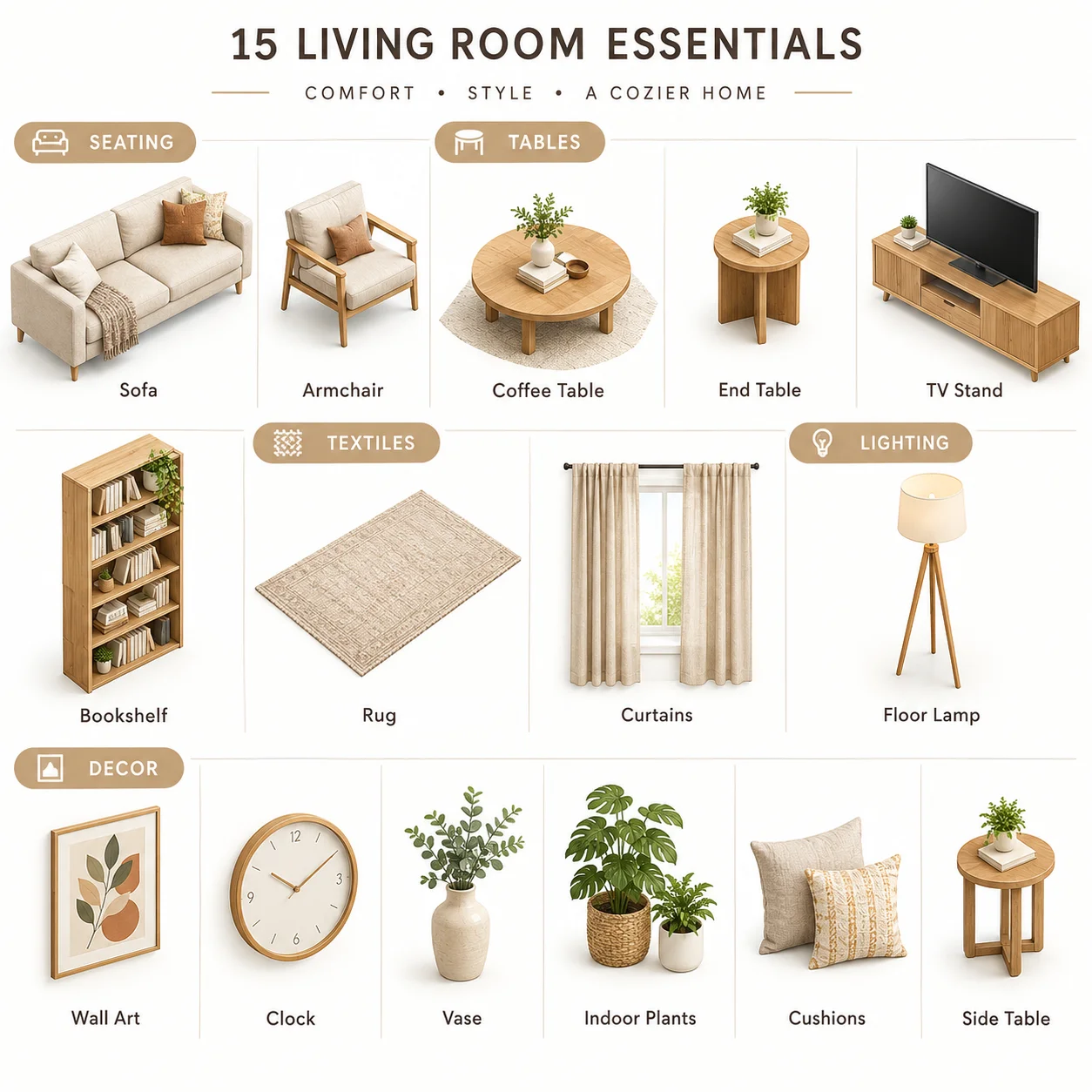
A well-planned arrangement should allow the main furniture pieces to work together without blocking doors, windows, or the primary walking path.
Seating: Where Everyone Sits
Seating is one of the main factors that determines how a living room functions. A basic arrangement may include a sofa, an armchair, and cushions, with additional seating such as a wing chair or rocking chair when space allows.
A sofa or couch provides the main seating for family members and guests. An armchair can create a dedicated reading or resting spot, while an additional chair can provide flexible seating when there is enough space.
The sofa usually works as the main anchor of the seating arrangement. Its position should relate to the room’s focal point while leaving enough space for circulation. An armchair can be positioned to the side of the main seating area, near a suitable light source when it is intended for reading.
Cushions add comfort, texture, and an opportunity to introduce color without replacing the main furniture.
Tables and Storage: What Holds Your Things
Tables and storage pieces make a living room more practical. A coffee table provides a convenient surface for drinks, books, and remotes, while an end table can hold a lamp and other small everyday items.
A bookshelf can provide vertical storage for books and decorative objects. A TV stand or media console can provide a stable location for the television while also offering storage for media equipment and other items.
Before buying a coffee table, measure the space between the sofa and the table. The table should provide a useful surface without interrupting the main walking path, especially in a small room.
In a compact living room, a smaller coffee table can preserve circulation while still providing enough surface area for everyday use.
Light, Textiles, and Decor
Furniture alone does not determine how comfortable a living room feels. Lighting, rugs, curtains, cushions, plants, and wall decor can add softness, texture, and visual interest.
Key comfort and decor elements can include an area rug, curtains, floor or table lamps, wall art, cushions, plants, and decorative accessories. Some homes may also have practical features such as an air conditioner, fan, fireplace, or media equipment.
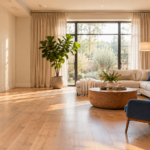
Curtains are typically installed around windows to provide privacy, control natural light, and add softness. A floor lamp can be placed near an armchair or sofa when focused reading or task lighting is needed. Wall art can be grouped at a suitable viewing height, while clocks, vases, and plants can add smaller decorative details.
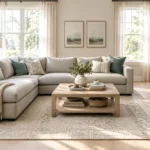
An area rug can help define the seating zone and visually connect the main furniture pieces. When the front legs of the sofa or chairs sit on the rug, the seating arrangement can feel more unified.
Decorative pieces do not need to fill every available surface. A few appropriately scaled pieces, such as artwork, a large vase, a clock, or an indoor plant, can add personality while keeping the room visually organized.
5 Things to Prioritize in a Small Living Room
In a small living room, the goal is not to fill every available corner. Prioritize the pieces that support seating, useful surfaces, comfort, light control, and everyday activities.
The five priorities are
- Sofa or main seating Provides the primary place to sit and relax.
- Coffee table or useful surface Provides space for drinks, books, remotes, and everyday items.
- Area rug: Helps define and visually connect the seating zone.
- Curtains or window treatment provides privacy and light control.
- Suitable lighting Provides general, task, or ambient illumination.
The exact combination depends on the room’s size, layout, and purpose. A compact room may need fewer pieces, while a larger family room may have space for additional seating, storage, and decorative elements.
Avoid choosing furniture solely because it looks large or comfortable in a showroom. Consider the furniture’s actual dimensions, doorway clearance, walking paths, and relationship to other pieces in the room.
Where to Put Things in the Living Room
Start by identifying one main focal point, such as a TV, fireplace, large window, or architectural feature. Arrange the main seating in relation to that focal point, then add tables, storage, lighting, and decor.
Position the sofa where it supports the focal point and leaves a clear path through the room. In many layouts, this means placing it along a major wall, but a sofa does not always need to sit against a wall.
An armchair can be positioned beside the main seating area, while a coffee table should remain close enough to be useful without interrupting circulation. End tables can sit beside sofas or chairs where lamps and small everyday items are needed.
A TV should generally be positioned so the main seating can view it comfortably without awkward angles. The exact location depends on the room’s shape, windows, doors, and other focal points.
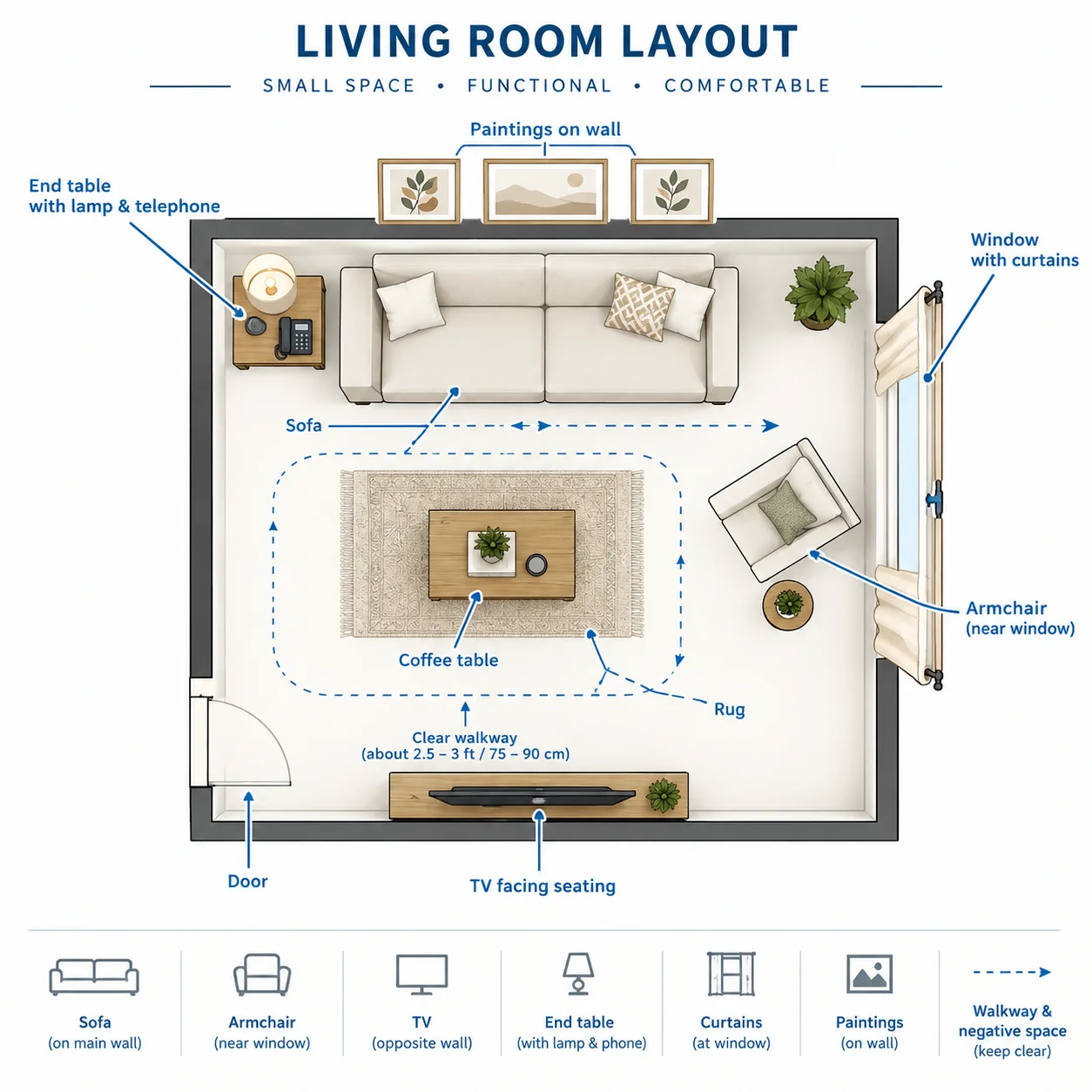
Curtains should be positioned around windows without interfering with furniture, doors, or heating and cooling equipment. Keep windows, doorways, vents, and air-conditioning units accessible when planning the layout.
A clear walkway is important because furniture should support movement rather than create obstacles. Leaving some open space can also make the layout feel less crowded.
Rather than automatically pushing every piece against the walls, consider how the seating arrangement supports conversation, viewing, reading, and movement. In some rooms, floating a sofa or creating a defined seating zone can improve the overall layout.
What Do You Actually Do in a Living Room?
A useful living room should support the activities that happen there every day. The furniture arrangement can change depending on whether the room is mainly used for watching TV, reading, entertaining, working, relaxing, or children’s play.
| Activity | Useful Living Room Setup |
|---|---|
| Watching TV | Comfortable seating facing the TV |
| Reading | Armchair with a nearby floor or table lamp |
| Entertaining | Extra seating and a convenient table |
| Family time | Comfortable seating with clear circulation |
| Working | Small desk or table near a suitable outlet |
| Children’s play | Open floor area with a practical, soft rug |
The TV does not have to be the only focal point. A fireplace, large window, artwork, family picture, or architectural feature can also provide a visual anchor.
For entertaining, provide enough seating and a convenient surface for drinks or serving items. For reading, position a comfortable chair near suitable lighting. For working, use a small table or desk where an outlet is accessible. Children’s play may require an open floor area and a durable, easy-to-clean rug.
A multifunctional living room works best when furniture placement leaves enough flexibility for different activities without blocking the main walkway.
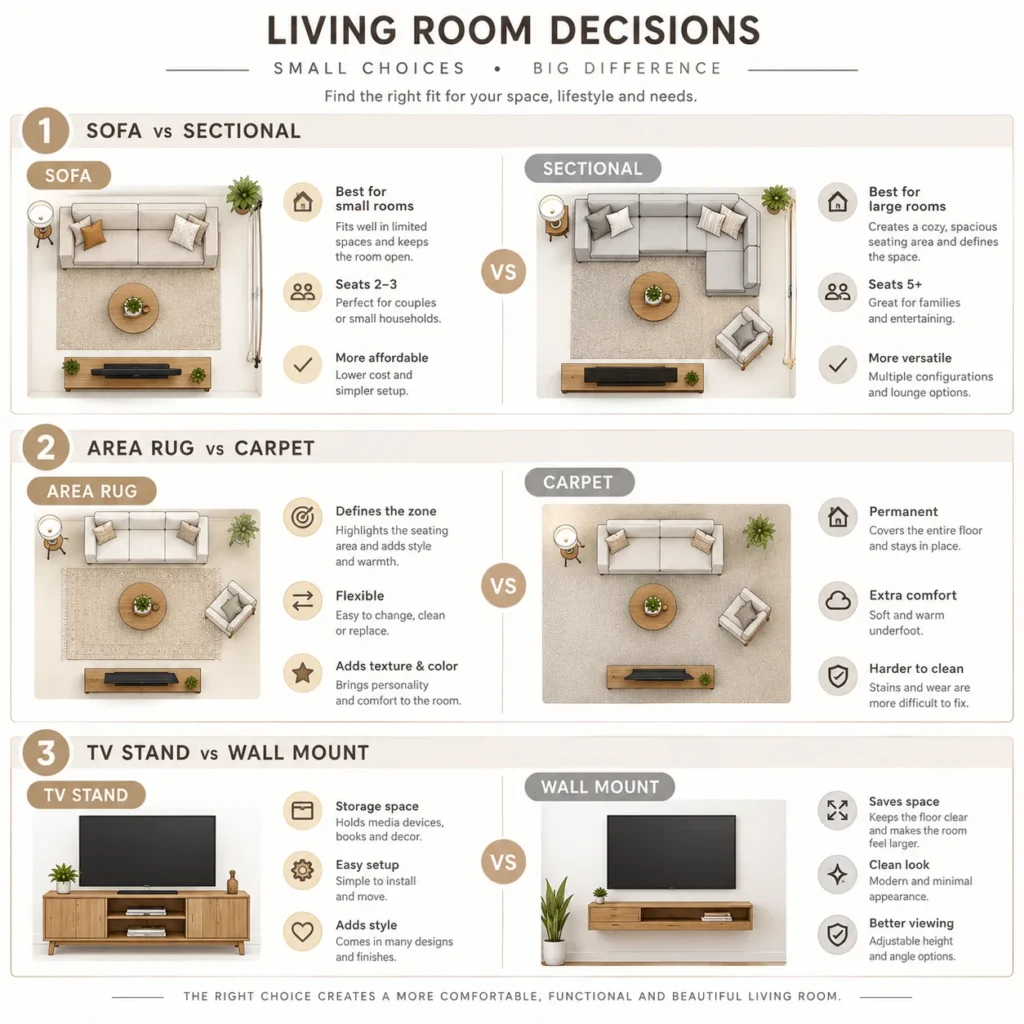
Sofa vs. Sectional, Rug vs. Carpet, and TV Stand vs. Wall Mount
Choosing between common living room options depends on room size, seating needs, layout, storage, flexibility, and circulation.
| Choice | Better When | Main Benefit | Watch Out For |
|---|---|---|---|
| Sofa | Compact or flexible rooms | Easier to position and move | Fewer seats |
| Sectional | Larger rooms or defined seating zones | More seating | Can dominate a small or irregular room |
| Area Rug | Flexible or rental spaces | Defines the seating area | Needs the right scale |
| Carpet | Whole-room softness | Covers the entire floor | Less flexible |
| TV Stand | Storage is important | Provides media storage | Uses floor space |
| Wall-Mounted TV | Floor space is limited | Frees floor area | Requires a suitable wall and installation |
Sofa vs. Sectional
A sofa may be easier to position in a compact or flexible room because it generally takes up less floor space and can be moved more easily.
A sectional can provide more seating and help create a defined seating zone, but its larger footprint may make it difficult to position in a small or irregular room.
Instead of using a fixed square-footage rule, consider the actual dimensions of the room, doorway clearance, furniture measurements, and walking paths before choosing between the two.
For additional layout inspiration, explore [living rooms with sectionals] for ideas that show how sectionals can work in different room arrangements.
Rug vs. Carpet
An area rug can define the seating zone while providing flexibility. It can also be replaced or moved more easily than permanent flooring.
Carpet provides softness across the entire floor and can create a consistent surface throughout the room, but it is less flexible when you want to change the room’s layout or style.
An appropriately sized rug should relate to the seating arrangement rather than appearing too small for the furniture.
TV Stand vs. Wall Mount
The choice between a TV stand and a wall-mounted TV often comes down to storage, floor space, installation, and viewing height.
A TV stand can provide shelves or cabinets for media equipment, books, boxes, and other items. A wall-mounted TV can free floor space and create a cleaner appearance, but it requires a suitable wall and appropriate installation.
Choose the option that fits the room’s storage needs and layout rather than selecting one simply because it looks cleaner or more modern.
Living Room Decoration Ideas That Make Everything Work Together
A room can contain attractive furniture and still feel disconnected if the pieces do not relate in scale, placement, color, or texture. Good living room decoration focuses on how the elements work together rather than simply adding more items.
Start with one focal point, such as a TV, fireplace, large window, or architectural feature. Arrange the main seating so it relates naturally to that focal point.
An area rug helps define the seating zone and connect the furniture visually. When the front legs of the main seating sit on the rug, the furniture can feel more unified.
Layered lighting combines different sources for different purposes. Overhead lighting can provide general illumination, floor lamps can provide focused light, and table lamps can provide softer illumination at a lower level.
Relying on a single overhead light can provide less flexibility than using multiple light sources at different heights. Combining lighting types can make it easier to adjust the room for reading, entertaining, relaxing, or general use.
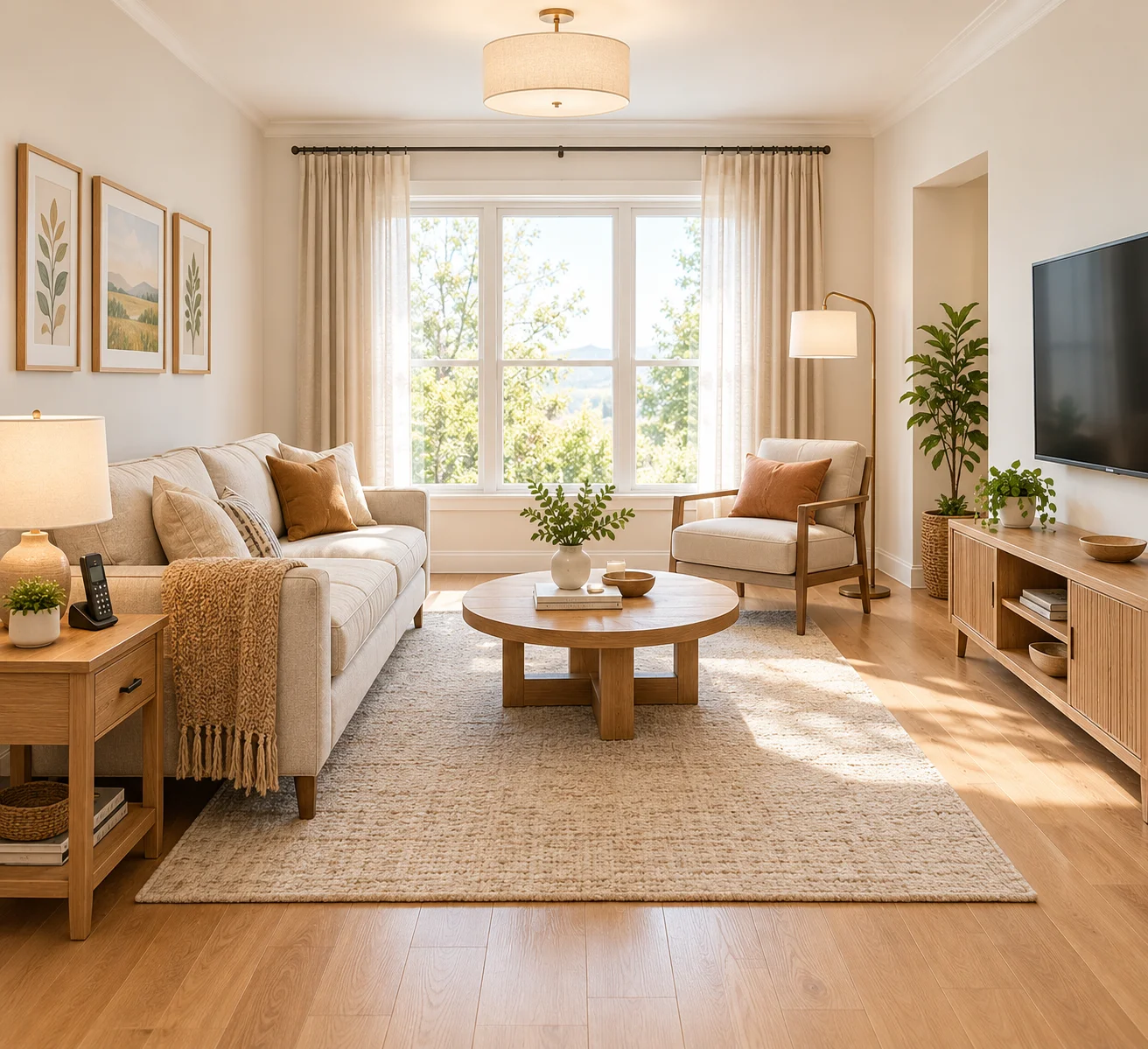
Wall art can be arranged as a group at a suitable viewing height. Leave some negative space between decorative elements so the walls and surfaces do not become visually crowded.
Furniture and decor do not need to match perfectly. Instead, connect the room through complementary colors, materials, shapes, textures, and scale.
For additional inspiration, explore high-end living room ideas that use warm minimalism and natural materials. Living room interior design works best when comfort and visual balance are considered together rather than when every surface is filled with decorative objects.
How to Pick Things for a Small Living Room
Choosing things for a small living room starts with measurements and priorities. Focus on furniture that supports daily activities while leaving enough space for movement.
1. Measure Before Buying
Measure the room, doorways, windows, and available wall space before choosing furniture. Check the dimensions of each item against the space where it will be placed.
2. Choose Furniture by Scale
Look for furniture that fits the room without overwhelming the available floor area. A compact sofa may be easier to position than a large sectional, depending on the layout.
3. Use Vertical Storage
Tall bookshelves and wall-mounted storage can use vertical space while preserving floor area. This can be especially useful when storage is limited.
4. Keep the Floor Visually Open
Furniture with visible legs and a carefully planned layout can help maintain an open visual feel. Avoid placing unnecessary pieces in areas needed for circulation.
5. Limit Decorative Clutter
Choose a few useful or meaningful decorative pieces instead of filling every table, shelf, and corner. Larger, appropriately scaled pieces can sometimes create more visual impact than many small accessories.
6. Protect the Main Walkway
Keep the primary route through the room clear of coffee tables, chairs, storage furniture, and other obstacles. Windows, doors, vents, and air-conditioning units should also remain accessible.
An area rug can help visually connect the seating area when it is correctly scaled to the furniture. Curtains can add height and softness around windows, while vertical shelving can draw attention upward.
Multifunctional furniture can also be useful in compact rooms. Storage ottomans, nesting tables, slim consoles, or furniture with built-in storage can provide more than one function without requiring additional large pieces.
The goal is not to fill every corner of a small living room. A balanced layout leaves enough open space for movement and allows the furniture to serve the activities that matter most.
Frequently Asked Questions About Things in the Living Room
Q: What are things in the living room called in English?
Things in a living room can be grouped into several categories: seating such as sofas and armchairs; tables and storage such as coffee tables, end tables, TV stands, and bookshelves; textiles such as rugs and curtains; lighting such as floor and table lamps; and decor such as wall art, plants, clocks, and vases.
Q: What are the 5 most important things in a living room?
Five common priorities are main seating, a coffee table or useful surface, an area rug, curtains or another window treatment, and suitable lighting. The exact items depend on the room’s size and how it is used.
Q: Where should I put my sofa and TV in the living room?
Position the sofa in relation to the room’s focal point while keeping the main walkway clear. Place the TV where the primary seating can view it comfortably without awkward angles. An armchair or side table can then be added without blocking circulation.
Q: What do people actually do in the living room?
People commonly use living rooms for relaxing, watching TV or movies, reading, socializing, entertaining guests, working, hobbies, and children’s play. The furniture arrangement should reflect the activities that happen most often.
Q: What things make a small living room look bigger?
A small living room can feel more open when furniture is properly scaled, the main walkway stays clear, storage uses vertical space, and decorative clutter is limited. An appropriately sized rug can also help visually connect the seating area, while furniture with visible legs can keep more of the floor visually open.
Q: Do I need a TV in my living room?
No. A TV is optional. A living room can instead use a fireplace, large window, artwork, built-in shelving, or another feature as its focal point. Seating can also be arranged toward one another to encourage conversation.
Q: What can I do with empty living room space?
Avoid filling empty areas simply for decoration. Use open space to improve circulation, add one appropriately scaled chair or floor lamp, create a reading corner, add vertical storage, or leave the area open when it helps the room function better.
Q: Is it living room or livingroom?
The standard English spelling is living room, written as two words. “Livingroom” is not the standard spelling.
Q: What is the difference between a living room, family room, and great room?
A living room is generally a shared sitting or entertaining space. A family room is typically designed for more casual everyday use, while a great room combines multiple functions, such as living, dining, and sometimes kitchen areas, in one larger open space. The terminology can vary by home and region.

Pingback: Living Room Without Carpet: 7 Smart Ways to Make It Cozy
Pingback: Ideas for Computer Desk in Living Room: 10 Smart Setups
Pingback: Family Room vs Living Room: 7 Clear, Practical Differences
Pingback: Ideas for Accent Walls in Living Room: 18 Easy Upgrades
Pingback: Storage Cabinet for Living Room: 7 Smart Buying Tips
Pingback: Home Interior Design for Small Homes: 10 Simple Smart Ideas
Pingback: DIY Room Decor for Small Apartments: 10 Space-Saving Ideas
Pingback: Neutral Color Palette Interior Design: 7 Simple Room Combos
Pingback: Guest Room Decorating Ideas: Make Any Spare Room Feel Welcoming - sfdecorstyle.comGuest Room Decorating Ideas: 15 Simple Touches Guests Love