
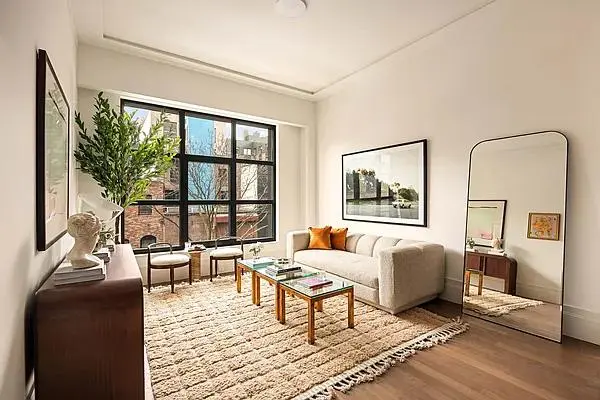

Most cramped apartments are not short on space. They are short on height. Everything the owner owns sits between the floor and eye level, so the ceiling stops counting as part of the room.
I have walked into studios smaller than my first bathroom that felt bigger than apartments twice the size. The difference was never the floor plan. Nothing in those rooms was stacked low.
Your eye goes where the objects point it. Pile frames, shelves, plants, and side tables into the lower half of the wall, and the eye parks there and stops looking. Hang one thing high, above a doorway or close to the ceiling, and the room grows upward in your head without gaining an inch.
DIY room decor for small apartments means projects you build or install yourself that add character without adding floor space. Wall-mounted pieces, removable finishes, and secondhand finds do most of the work. If you want the wider thinking behind interior design for small homes, that sits one step above the projects in this guide.
You are not buying space. You are redirecting attention.
So decide the order you will work in before you buy anything. Declutter first, because new decor piled on clutter just looks like more clutter. Measure second, since a tape measure costs nothing and a shelf that does not fit costs a return trip. Then prep the wall, mount the piece, and photograph that wall before you start so you have proof of its condition later.
Vertical first. Everything else is decoration.
What’s Inside
- Stop buying small furniture for a small room
- Measure these 3 things before you buy anything
- 10 DIY room decor ideas for small apartments
- How to hang wall decor in a rental without drilling
- Lighting and textiles do more than any accent wall
- Is painting a small room dark actually a mistake?
- Cheap DIY room decor for small apartments: what $0, $25, and $50 buy
- Small apartment decor mistakes that make rooms feel smaller
- The 3-5-7 rule, and when to stop adding things
- What your lease actually lets you do
- Your bedroom, living room, and studio, solved room by room
- Questions people actually ask
Stop Buying Small Furniture for a Small Room
Small room, small furniture. That rule sounds airtight, and it is the reason so many tiny apartments end up looking like dollhouses nobody finished.
Here is what actually happens. A small sofa, a small rug, and a narrow console do not free up the floor. They make the room look like it is full of leftover furniture from somewhere else. Nothing relates to anything, and a room where nothing relates reads as tight.
Scale is what your eye judges. Not size.
A rug that reaches under the front legs of the sofa tells your brain the seating area is one decided thing. That reads as calm, and calm reads as roomy. A postage stamp rug in the same spot reads as unfinished, and unfinished feels small.
I learned this the expensive way. I bought it small, replaced it twice, and only felt the difference when I went bigger than I was comfortable with.
So before you upgrade a single piece of decor, check what you already own against the size of the room. You may not need less furniture. You may need what you have to fit where it is, and how the room is set up usually matters more than what you buy for it.
Start with the rug. The rug sets the scale for everything sitting on it.

Measure These 3 Things Before You Buy Anything
You need three numbers before you spend a single dollar on small apartment decor. Wall length, ceiling height, and how far a piece will stick out into the room.
Wall length tells you what fits. Not what fits in your imagination, but what actually fits between the doorframe and the corner. I have watched people buy a lovely shelf, get it home, and discover it clears the light switch by nothing at all.
Ceiling height decides how high you can go. Ceiling height matters more than people expect in a small apartment, because older buildings often have beautiful heights, and new builds often have very little. A piece hung at the same height can look generous in one and crowded in the other.
The third number is projection. Stand in the room, look at a wall, and think about how far a shelf, a desk, or a chair will come toward you. A wall-mounted piece that sticks out two feet can end up eating the walkway you need every morning.
Then test your walkway with movement, not with tape. Open every cupboard and drawer that faces that floor and check that nothing blocks them. Walk the route you take at seven in the morning with your arms full. If you have to turn sideways, the piece you were considering is too deep, whatever the numbers said.
Write the three numbers on your phone. You will use them in a shop, in a secondhand listing, and in the comments of a tutorial you are following at eleven at night.

10 DIY Room Decor Ideas for Small Apartments
Here are ten space-saving decor ideas for small apartments, each one either built by me or watched falling apart in someone else’s flat. Every project lists what it should cost, how long it takes, how hard it is, whether it risks your wall, and how much floor it uses.
All ten are wall-mounted or floor-free, which is why they suit a small apartment. Costs below are rough estimates in US dollars, and they move with the shop and the season. The secondhand route is usually cheaper than any number printed here.
| Idea | Cost band | Time | Difficulty | Wall risk | Floor used |
|---|---|---|---|---|---|
| Picture ledge above a doorway | $15 to $30 | 30 to 45 min | 1 of 5 | Low | None |
| Peel and stick accent wall. | $25 to $60 | 2 to 3 hrs | 3 of 5 | Low | None |
| Joint compound textured art | $15 to $25 | 1 hr plus drying | 2 of 5 | None | None |
| Paper fan wall piece | $5 to $10 | 1 hr | 1 of 5 | Very low | None |
| Mirror across from a window | $20 to $60 | 15 min | 1 of 5 | High if hung | Small |
| Painted pegboard | $20 to $35 | 1 hr | 2 of 5 | Medium | None |
| Leaning ladder rack | $0 to $40 | 10 min | 1 of 5 | None | About one square foot |
| Fold down the desk. | $30 to $60 | 2 hrs | 4 of 5 | Medium to high | None when closed |
| Under bed storage | $0 to $25 | 30 min | 1 of 5 | None | None |
| Removable molding frames | $20 to $40 | 1 to 2 hrs | 2 of 5 | Low | None |

Shelf Where Nothing Else Fits
The strip of wall above a door is the most wasted space in any apartment. A narrow picture ledge screwed or stuck up there holds books, small plants, and frames, and it eats zero floor.
The picture ledge is the first project I do in a new place. A ledge costs less than lunch, takes half an hour, and instantly pulls the eye upward. Load it lightly and space the objects out. A crowded ledge looks like a shelf in a storeroom.
One detail the tutorials skip. A floating shelf needs a fixing that can take the weight and the lever force, because everything on it pulls outward as well as down.
Bracketed ledges are far more forgiving than floating ones. If you rent and cannot drill, a narrow ledge on adhesive strips will hold books and small plants but will not hold a heavy frame.
A Wall That Isn’t a Wall Yet
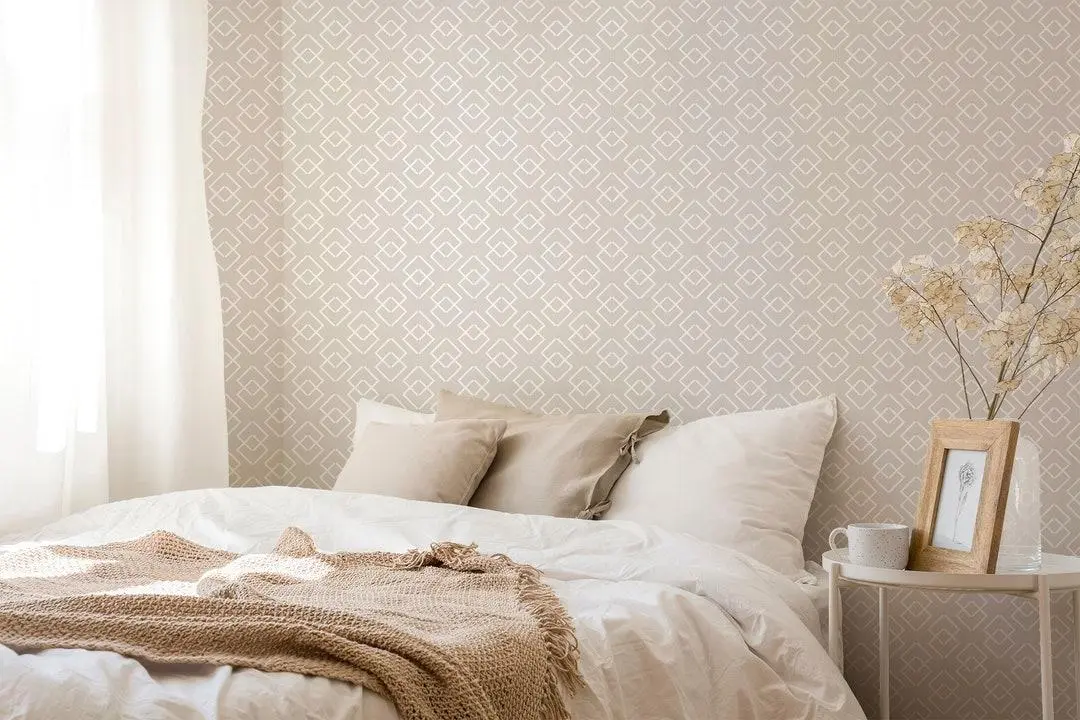
Peel and stick wallpaper gives you an accent wall you can remove in an afternoon. Renter friendly decor does not get much closer to real paint than this, and it costs a fraction of what a decorator would charge.
Prep matters more than the product. Wipe the wall, let it dry completely, and start from a clean corner. On old paint that has started to lift at the edges, the wallpaper will pull it further. Test a small strip in a hidden spot first.
The Cheapest Art You’ll Actually Keep
Spread joint compound on a canvas with a putty knife, let it set, and you have a textured, expensive-looking piece for the price of a tub of filler. I made one for a hallway, and it is still the thing guests ask about.
Build texture in thin layers. A thick slab cracks. And do this on a surface you can move, not on the wall itself, unless you enjoy cleaning.

Paper Fan Wall Piece
Fold heavy paper into accordion fans, join them in a row, and hang the whole thing above a bed or a sofa. A paper fan piece weighs almost nothing, so adhesive strips handle it easily.
This is the project I recommend to anyone who has never made anything before. Paper fans are nearly impossible to do badly, and one row fills a big empty wall for the price of a coffee.
The Mirror Rule
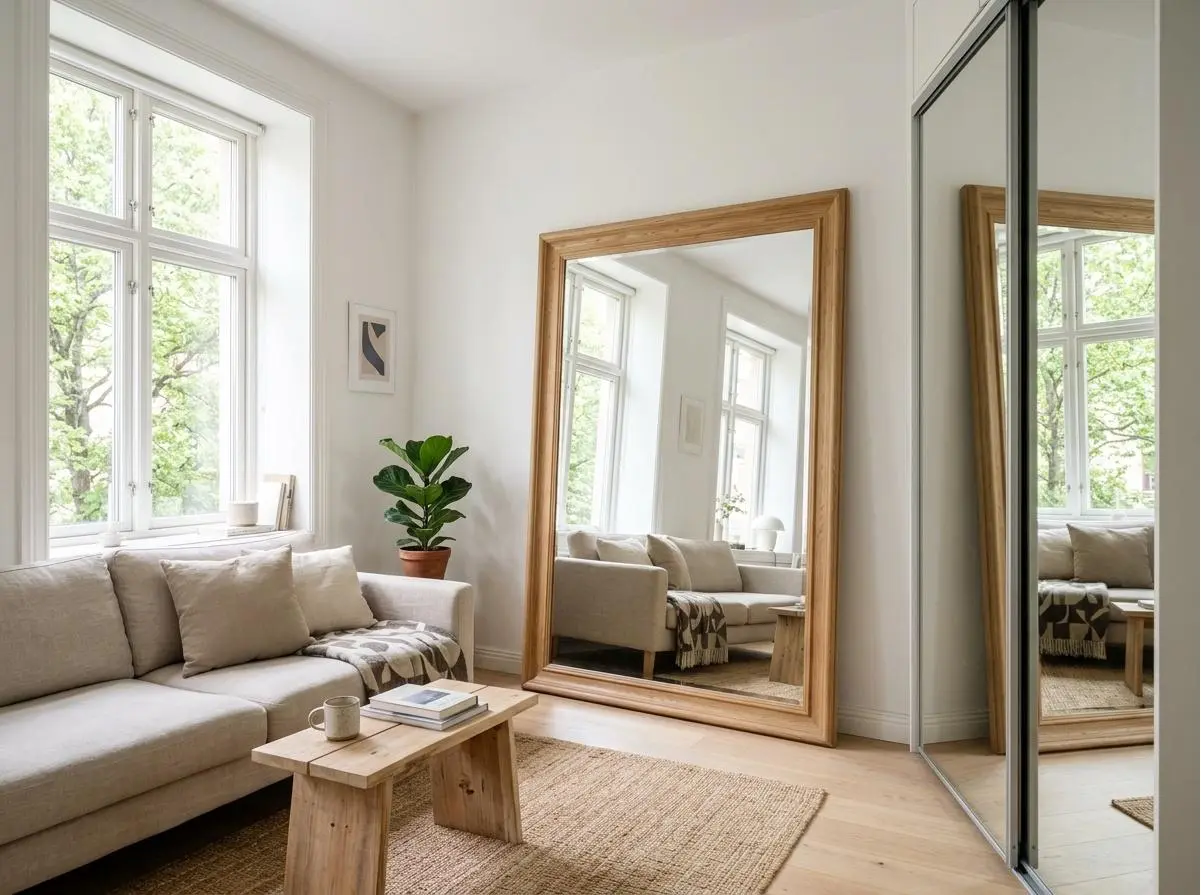
Put a mirror across from a window, and the room gets a second source of daylight. Reflections carry brightness deeper into the space than the window alone manages, and a room that is bright at the back reads as larger than it is.
I have never seen this trick work when the mirror faces a blank wall or the back of a sofa. All it does then is show you the thing you were trying to hide.
Renters should think about fixing. A full-length mirror leaned rather than hung avoids the whole problem, and a mirrored wardrobe door does the same job with no mounting at all.
Storage That Doesn’t Look Like Storage
A cheap pegboard painted the same color as the wall holds tools, jewelry, keys, and cables, and it reads as a display rather than an organizer. Hang a pegboard in a corner, and it quietly becomes a workspace.
Keep the paint color close to the wall. Contrast is what makes pegboards look like a garage. If open shelves are not your thing, a closed storage cabinet hides the same clutter and asks nothing of your styling.
Leaning Ladder Rack
A wooden ladder leaning in a corner holds throws, magazines, and trailing plants in about one square foot. A ladder rack needs no fixing, no tools, and causes no damage at all.
Buy secondhand or use one you already have. Just check it stands steady, and lean it against a wall that will not be knocked.
A Desk That Disappears
A fold-down desk gives you a work surface that is gone by dinner. A wall-mounted desk is the single best answer for a studio where the living room and the office are the same eight feet, though putting a desk in a living room works fine too if you have the floor to spare.
This is the hardest project on the list. A fold-down desk needs solid fixing into a stud or proper wall anchors, and it needs a hinge that can take weight. If you rent and cannot drill, skip this one.
Six Inches of Floor
Flat bins and zipped fabric bags under the bed hold bedding, out of season clothes and shoes, and they use space you were never going to walk on. Under bed storage is the easiest thing in this article.
Measure the clearance first. A bin that does not slide is a bin you will stop using.
Removable Molding Frames
Lightweight trim stuck to a wall in rectangular frames gives you the look of paneling with none of the carpentry. Removable molding reads as architecture, which is exactly what a plain rental wall lacks.
Lay the rectangles out on the floor first. Spacing is the whole trick, and a lopsided grid is very hard to unsee.
Removable decals and tapes do the same job for a fraction of the effort. A washi tape border around a window costs almost nothing and comes off without a mark.
Which Project for Which Problem
Nobody searches for a project. People search for a problem. Find yours in the left column.
| If your problem is | Do this | Cost band |
|---|---|---|
| The walls feel bare | Picture ledge above a doorway | $15 to $30 |
| The room feels dark at the back | Mirror across from a window | $20 to $60 |
| There is nowhere to put anything down | Wall mounted baskets or a pegboard | $20 to $35 |
| It feels like one undivided box | A rug plus a lamp to mark a zone | $25 to $80 |
| Nothing has any personality | Joint compound textured canvas | $15 to $25 |
| You cannot drill anything | Paper fans and removable trim | $5 to $40 |
| You need a desk but have no room | Fold down desk | $30 to $60 |
How to Hang Wall Decor in a Rental Without Drilling
Adhesive strips work, and they fail for reasons that have almost nothing to do with the strip. The wall condition and your patience decide the outcome.
Creative wall decor ideas for renters all depend on this one section more than any other, so read it before you buy anything sticky.
Which Strip for Which Weight
The pack tells you the limit, so read it before you buy. 3M rates its large picture hanging strips at roughly 15 pounds, which is plenty for a framed print and nowhere near enough for a mirror with a wooden frame.
That single number explains most of the damage I have seen. Someone hangs a mirror on strips meant for a poster, and three weeks later it comes down at two in the morning.
Weigh the thing first. A suitcase scale and a hook work fine for this.
The Prep That Decides the Outcome
Wipe the wall with rubbing alcohol and let it dry fully. Dust and cooking grease are the quiet cause of most failures, and neither is visible.
Then wait. If the wall was painted recently, give the paint about seven days to cure before you stick anything to it. Painting and decorating on the same weekend is the most common mistake in this whole process.
Do not use adhesive strips on wallpaper at all. The paper comes off with the strip, and the patch underneath is not something you can hide.
Wall Surface Compatibility
The strip is rarely the reason a wall gets damaged. The surface underneath it usually is.
| Wall surface | Adhesive strips safe? | What happens |
|---|---|---|
| Freshly painted, cured | Yes | Best case. Wipe with alcohol first |
| Freshly painted, under 7 days | No | Paint lifts with the strip |
| Old paint, flaking edges | Test first | Strip can pull a patch of paint |
| Wallpaper or lining paper | No | Paper tears away from the wall |
| Textured or stippled plaster | No | Adhesion is too weak to hold |
| Tiles, glass, sealed wood | Yes | Clean and dry fully first |
| Bare plaster or unpainted drywall | No | Strip bonds to the surface itself |
Taking It Down Without Taking the Paint With It
Pull the tab straight down, slowly, along the wall. Do not pry outward. The angle is what tears paint.
On older paint, test one small strip somewhere nobody looks. If the paint lifts there, you know what the rest of the wall will do before you have committed to anything visible.
If a patch does come away, fill it, sand it light, and touch it up with the paint the landlord left behind. Which you should ask for the day you move in.
Lighting and Textiles Do More Than Any Accent Wall
Light changes how big a room feels faster than paint does. A dark corner reads as the edge of the space, so the room stops there in your head.
I would spend money on light before I spent it on a feature wall. Every time.
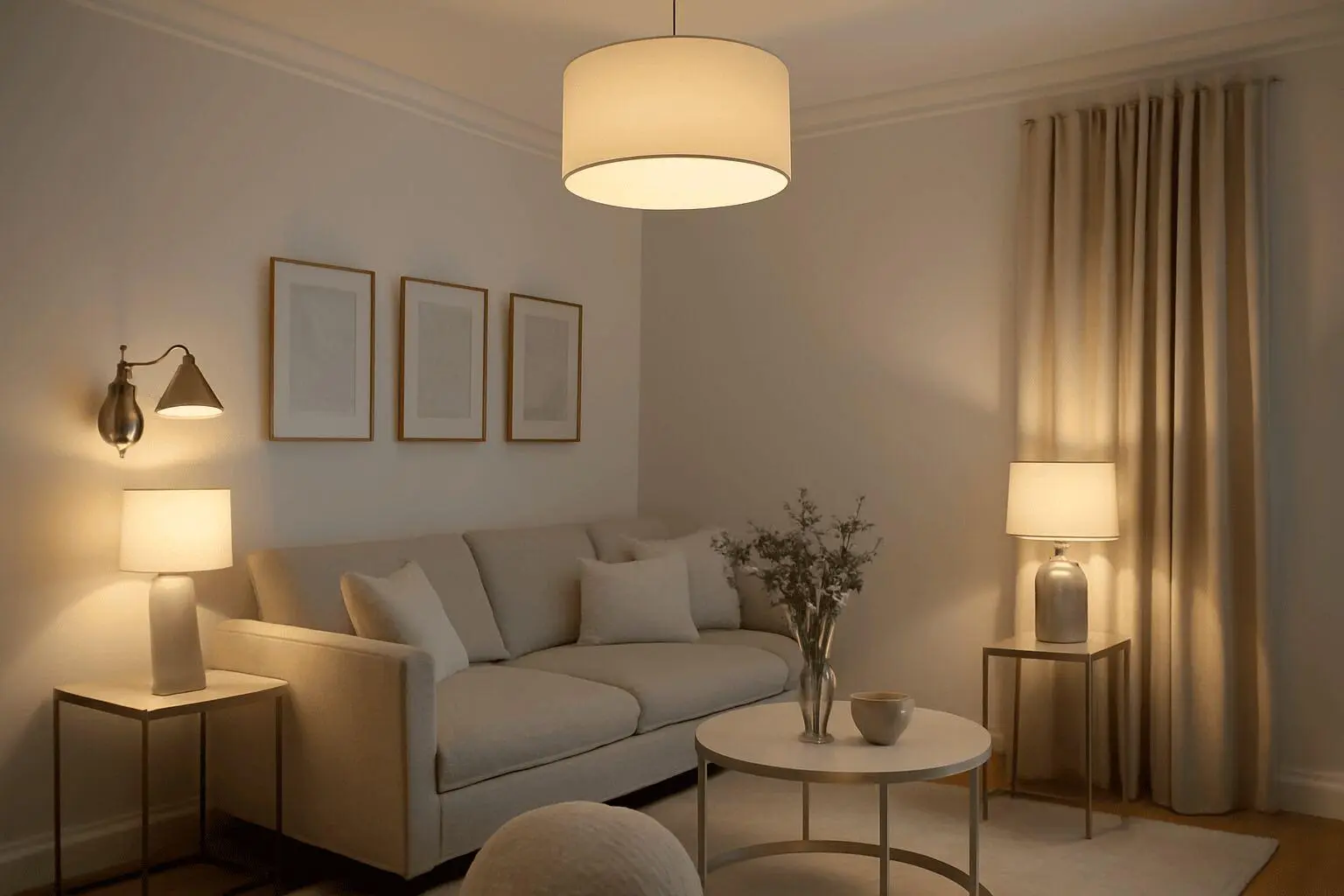
Plug in wall sconces and battery powered strip lights give you warm light with no electrician and no holes. Look for warm white bulbs around 2700K. Cooler 4000K light reads like a bathroom and makes a small room feel clinical, which is the opposite of what you want.
Two light sources beat one bright one. A single overhead light flattens a room and turns every corner into a shadow. A lamp in the dark corner plus a sconce on the opposite wall gives the room depth, and depth is what your eye reads as size.
Run the cord along the skirting and hide it with a cable cover, or pick a cordless sconce and skip the problem completely.
Then add textiles. Cushions, a throw, a runner, a second hand rug. Fabric softens sound, which is why a bare small apartment feels like a corridor even when it looks fine. Rooms with no carpet need this most, because there is nothing underfoot to absorb anything.
Balance matters here. If all your light and all your soft things sit on one side of the room, the other side goes flat and the space feels lopsided. Put a lamp or a plant on the empty side and the whole room settles.
Is Painting a Small Room Dark Actually a Mistake?
No. Dark paint is a choice about mood, not a rule about size, and a dark wall can be the right answer in a very small room.
The advice you have heard is not wrong, it is just narrower than it sounds. Cool pale tones with blue or green undertones make a wall visually step back, which reads as open. That is about undertone, not brightness, and it is why some pale walls feel flat while others feel airy.
Dark and saturated colour does the opposite job. Dark paint pulls the walls in and makes the room feel enclosed and calm, which is a real thing to want in a bedroom or a corner meant for reading.
So pick the feeling, not the rule. Airy and open, or warm and close. Both are legitimate. Neither is a mistake.
If you cannot paint, peel and stick wallpaper and removable panels get you most of the way there, and there are accent wall ideas that need no paint at all. One caution. In a room with very little daylight, cool greys and icy blues can look cold rather than fresh. Warmer undertones survive bad light better.
Cheap DIY Room Decor for Small Apartments: What $0, $25, and $50 Buy
Three price points, three different kinds of progress. The free one is not the weakest of the three, and most people skip it.

$0 Rearrange Before You Buy
Take one thing out of the room. Then lift one thing off the floor and put it on a wall. Then move one piece of furniture a few inches away from the wall it has been pressed against since you moved in.
That is it. No shopping, no tools, and a free rearrange changes a room more than most purchases do. The hollow space in the middle of a wall hugging room is usually the real reason it feels small.
$25 One Material, One Project
At this level, buy one good thing instead of four cheap things. A tin of paint for a single shelf. A roll of heavy paper. Two metres of fabric. A mirror from a charity shop.
Small budget decorating fails when it spreads thin. One finished object beats six half started ones sitting in a cupboard.
$50 The Project That Changes the Room
Fifty dollars is enough for an accent wall if you buy peel and stick on sale, or a second hand mirror, or a set of picture ledges across an empty wall.
The best use of this money is the wall you look at from the sofa. Fix the thing you see most, not the thing you see last.
Where to Buy the Materials Without Overpaying
Material cost is where a cheap project quietly stops being cheap. The same roll of peel and stick wallpaper can differ by more than double between a craft shop and a discount store, so price the material before you commit to the project, not after.
Three routes I use, in the order I try them. A hardware shop for fixings, strips, adhesive and paint, because you get correct specifications and a person to ask. A fabric or craft shop for paper, trim and textile, where the remnant bin often beats new stock.
And second hand marketplaces for anything with a frame, a shelf or a hinge, where the object itself is usually the cheapest part of the whole project. Once an older piece lands in the room, mixing antiques with modern pieces is the part that decides whether it looks collected or just old.
One rule. Never buy adhesive or wall fixings second hand. A strip that has already been stuck and pulled has lost its grip, and you will not find out until the frame is on the floor.
Small Apartment Decor Mistakes That Make Rooms Feel Smaller
Four of the five mistakes below are not taste problems. The four are order problems, or patience problems, and that is why they happen to people with excellent taste.
Pushing everything against the walls. It creates a hollow centre that your eye reads as unused, not as space. Pull the main piece of furniture out a few inches and the room starts to work. Sectional sofas are the hardest to float and the ones worth trying hardest with, because everything else in the room can be arranged around them.
Sticking adhesive to fresh paint. The strip holds fine until the paint finishes curing and takes the top layer with it. Wait the seven days.
Buying the rug too small. A rug that floats between the furniture breaks the room into pieces. Go as large as the room allows, and put the front legs of the seating on it.
Decorating before decluttering. New decor added to clutter looks like more clutter. Remove first, then style what is left.
Trusting the word damage free as a guarantee. It means damage free when the wall was clean, the paint was cured, the surface was not wallpaper, and you removed it the right way. Skip one of those and the promise does not apply.
Notice the pattern. None of these five mistakes is about buying the wrong thing. Every one of them is about doing the right thing at the wrong moment, which is a much cheaper mistake to fix.
The 3-5-7 Rule, and When to Stop Adding Things
The 3-5-7 rule is a common styling guideline rather than a rule anyone enforces. The idea is that objects grouped in odd numbers, three, five or seven, look arranged, while even numbers look paired and stiff. Treat it as a starting point, not a law.
Here is how it works on a shelf about a metre wide. One larger anchor piece, slightly off centre. Then three smaller objects clustered near it, all touching. Then one or two things further out to break the symmetry. That gives you five objects around one anchor, which is roughly where the name comes from.
I use the rule as a stopping signal more than a starting one. When a surface reaches five objects and starts to feel busy, stop. If you are unsure which of the five earned their place, this guide to what actually belongs in a living room settles it faster than staring at the shelf does. Most small rooms do not fail because there is too little on the shelf. They fail because there is one object too many.
Try it tonight. Take one thing off every surface in the room and look again. Most people put one back, which tells you something.
What Your Lease Actually Lets You Do
You can decorate a rental without risking your deposit, and the protection comes from evidence rather than luck. Photograph everything before you touch it.
Take wide shots and close shots of every wall, the floor, the skirting and anything already marked. Save them with the date. Saving those photos is the single habit that settles most deposit arguments before they start.
Rental decorating rules differ from lease to lease, so start with the two things that stay the same everywhere. Understand what fair wear and tear generally covers. Small marks from living in a space are normal. A wall of filled holes you never mentioned is a different conversation.
Ask in writing when you are not sure. One short message saying what you plan to do, what you will use, and how you will remove it does more than a verbal chat in a hallway.
Rules vary a lot by country and by lease, so read your own agreement before you start. I cannot tell you what your landlord will accept. I can tell you that documented before and after photos have saved more deposits than any argument afterwards.
Renter friendly decor only stays renter friendly if you can prove the wall looked the same on day one. Two minutes of photographs is the whole price of that proof.
Your Bedroom, Living Room, and Studio, Solved Room by Room
Each room has one job that matters more than the rest.
Bedroom. Start with what is above eye level, because a cozy small bedroom has almost no floor to spare. Put a shelf or art high on the wall and keep the bedside surfaces nearly empty. And never hang anything heavy on adhesive strips directly over a bed, whatever the weight rating says.
Storage in a small bedroom almost always fails at the same point. There is nowhere to put anything down, so everything ends up on the nearest flat surface. Fix that with one wall mounted basket or a row of hooks before you buy a single piece of decor.
Living Room. Fix the seating and the rug before anything else. Pull the sofa off the wall, size the rug so the front legs sit on it, and only then add decor.
Getting this order wrong is why so many living rooms feel like waiting areas. Once the bones are right, living room theme ideas for apartments are worth a look, because the theme should follow the layout and not the other way round.
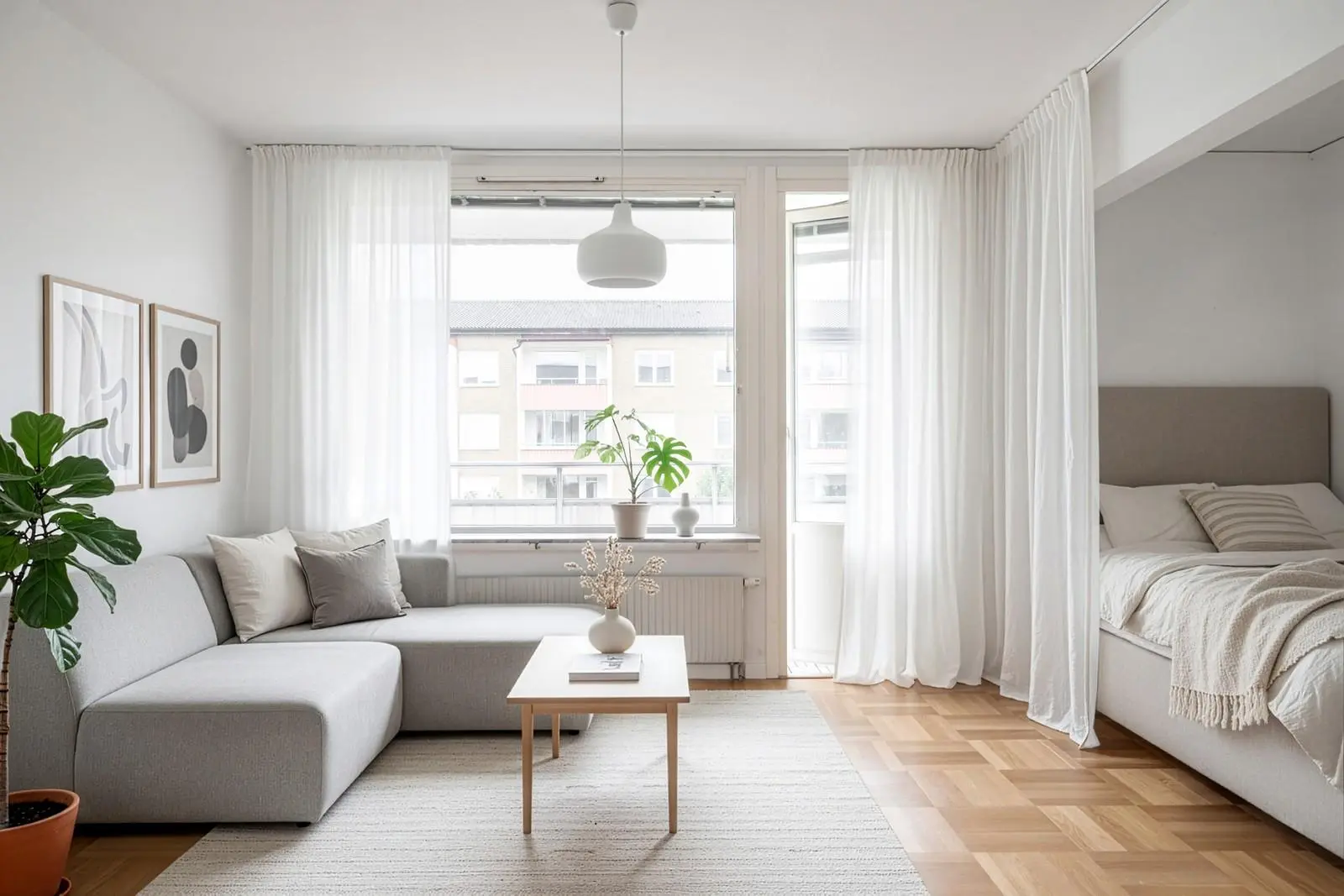
Studio. Zones do the work in a studio apartment layout. A rug, a lamp, or the back of a shelf can mark where sleeping ends and living begins without building a single wall.
Keep the sightline from the door to the window clear, because an interrupted sightline makes a studio feel tight no matter how much floor you have.
Two zones is enough for most studios. Sleep and everything else. Adding a third before the first two are settled makes the space feel busy rather than defined. If you want a separate office, the fold down desk is a better answer than a divider you have to walk around.
Questions People Actually Ask
How do I decorate a very small apartment? Go vertical, go removable, and take something out before you add anything. High shelves, a mirror across from a window and one wall of art will change a small apartment more than a van full of new furniture.
What is the 3-5-7 rule in decorating? Group objects in odd numbers, usually three, five or seven, with one larger anchor piece. It stops shelves from getting crowded and gives a surface a finished look.
Do adhesive strips really come off without damaging paint? Usually, yes, and only if the wall was clean, the paint had cured, the surface was not wallpaper, and you pulled the tab straight down instead of prying. On old paint, test a hidden spot first.
What are some DIY room decor ideas for small rooms? A picture ledge above a doorway, a paper fan wall piece, a textured canvas made with joint compound, wall mounted baskets and under bed storage. All cheap, all removable, none of them using floor space.
What are some small room apartment ideas that actually work? Start with what hangs rather than what stands. A ledge above a doorway, wall mounted baskets, a leaning ladder in a corner and under bed storage all add function without using floor. The projects that work in a small room are the ones you never have to walk around.
What are easy decor ideas for a small apartment? The easiest wins are a mirror across from a window, one wall of frames on adhesive strips, and removing anything you have not used in a year. None of these need tools, and all three can be undone in an afternoon.
Can I paint a small room a dark colour? Yes. Dark paint makes a small room feel warm and enclosed rather than cramped. Pick it when you want atmosphere, and pick a cool pale tone when you want the room to read as open.
How much does a small apartment makeover actually cost? Far less than people expect if you work in tiers. Rearranging and decluttering cost nothing. One material at about $25 finishes a single project. Around $50 buys an accent wall or a second hand mirror that changes a whole room.
What is the cheapest way to make a room look bigger? Put light in the dark corner, put a mirror across from the window, and remove one piece of furniture. That combination costs very little and works in almost any apartment.
Will removable wallpaper damage my walls? It can pull loose paint, especially on older walls. Test a small strip in a hidden spot, let it sit for a week, and remove it the way the instructions say before you commit to a whole wall.
Pick one project from this list. The one nearest the door you walk through every day. Do it this weekend, then stop and live with it for a while.
That is how DIY room decor for small apartments actually gets finished. One wall at a time, with a tape measure in your pocket and a photo of the wall on your phone.
If you only do one thing this month, do the wall you look at from the sofa. It is the wall you see most, and the one that will keep annoying you until it is fixed.

Pingback: Neutral Color Palette Interior Design: 7 Simple Room Combos
Pingback: Guest Room Decorating Ideas: Make Any Spare Room Feel Welcoming - sfdecorstyle.comGuest Room Decorating Ideas: 15 Simple Touches Guests Love
Pingback: Best Materials for Industrial House Interiors: 12 Picks
Pingback: Yellow Bedroom Ideas: 15 Easy Looks That Feel Calm and Warm
Pingback: Bedroom Decor With Plants: Simple Ideas for a Calm Space