
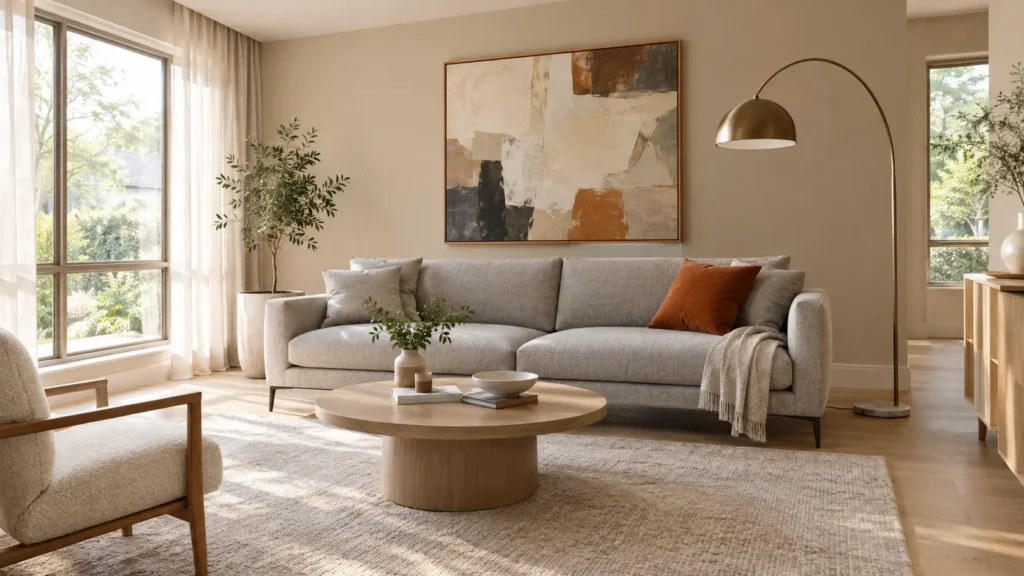

Ask three designers what contemporary interior design is, and you’ll get three different answers: all white and glass, warm and earthy, or just another word for modern. No wonder so many people give up and buy a beige sofa.
Here’s the simple version. Contemporary design is the style of right now. It isn’t a movement with rules or an end date, which is why it keeps changing while staying recognizably the same: clean lines, functional layouts, and restraint, dressed in whatever is currently in taste.
In this guide, you’ll get five quick tests to check if your room is already contemporary, the real difference between modern and contemporary, and simple fixes for rooms that feel cold.
Quick answer
- What is contemporary interior design? The style of the present moment clean lines, functional layouts, and restraint is applied to whatever is currently in taste.
- Is it the same as modern? No. Modern is a closed period (roughly 1920s–1950s). Contemporary is open-ended.
- What defines it? Exposed furniture legs, a neutral base with one accent, very light or very dark wood, edited decor, two-layer lighting.
- How do I spot it? Look at the bottom of the furniture. Visible legs, low profile, deep seats.
- Does it last? The grammar does. Individual trend pieces don’t refresh; they are part of the style.
Table of Contents
What Contemporary Interior Design Means
Start with the word, because it’s doing all the work. “Contemporary” means current. A contemporary room photographed thirty years ago and one photographed today don’t look much alike, and neither was wrong.
The history is shorter than people expect. The style grew out of what came after the mid-century period: pieces of modernism, pieces of what followed it, and pieces of the decorative eras people were still drawn to. Nobody wrote rules, because it was never a school or a movement—it was a filter.
That’s why it resists a checklist. Mid-century modern almost always means walnut-toned wood and tapered legs; that’s the giveaway. Contemporary has no equivalent signature, because it keeps absorbing whatever arrives next.
So what stays still while the surface moves? The grammar clean lines, deliberate space, function before decoration, restraint. That grammar has barely changed in half a century, even as everything standing on it has been replaced several times.
Which brings us to the question people actually type: what is contemporary design in interior design? In practice it’s simpler than the definition suggests. It’s the approach where you take a room down to its function first, then dress it with what’s currently in taste a low sofa with visible legs, a neutral base with one strong accent, one good light instead of six ordinary ones. The look changes with the decade. The sequence doesn’t.
One reframe worth keeping: stop asking What does contemporary look like? and start asking, “What does current taste look like, applied with clean lines?” That question has a different answer every year, which gets you closer to the meaning of contemporary interior design than any fixed definition can.
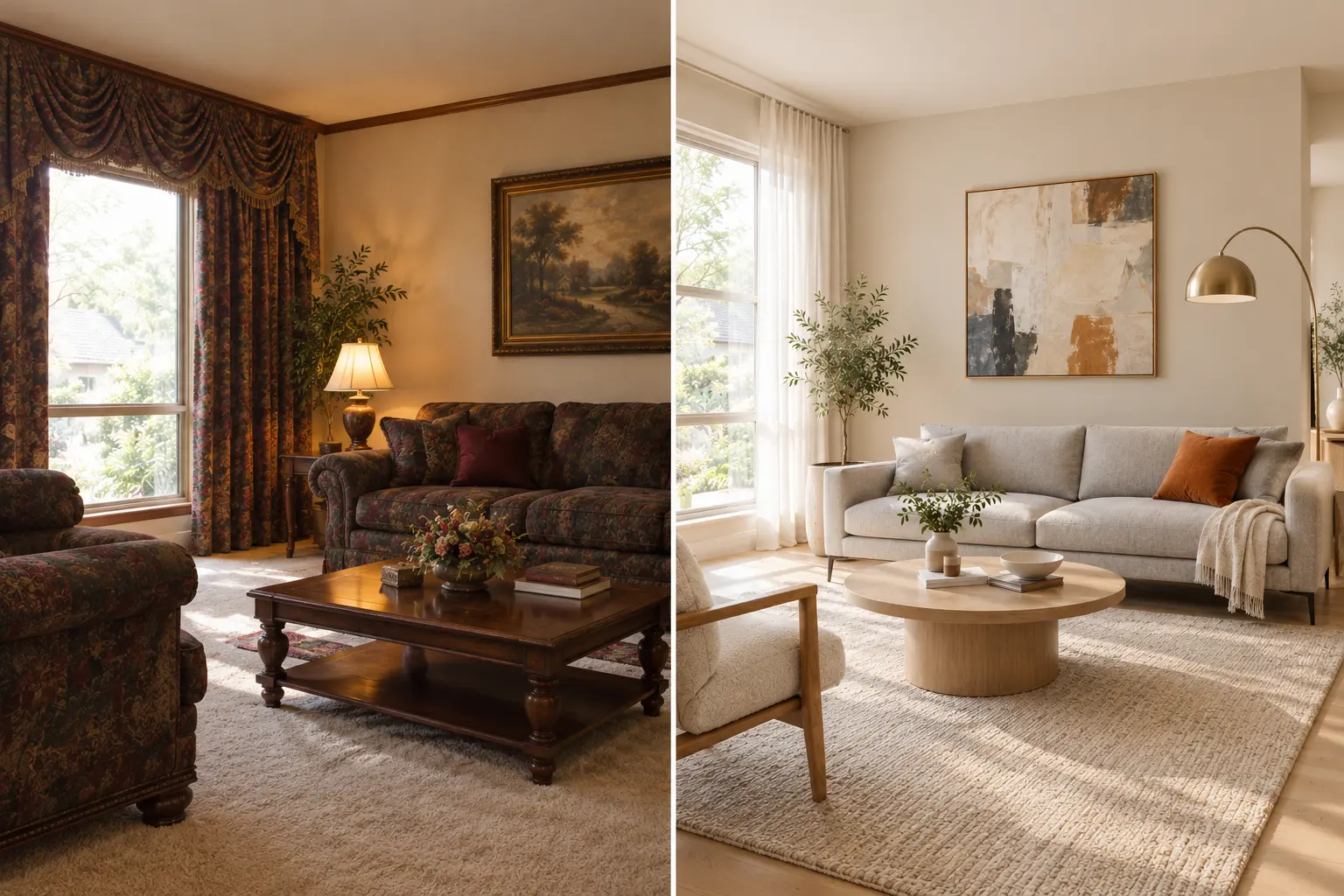
Contemporary Interior Design Characteristics: 5 Tests
Below is not a list of adjectives. “Clean lines” tells you nothing. Look at the legs” tells you whether your sofa belongs in this room.
The five tests at a glance:
- Are the furniture legs visible? Fails with skirts, slipcovers, or upholstery to the floor.
- Color one saturated accent, or several timid ones? Fails with three soft colors and no anchor.
- Materials is the wood very light or very dark? Fails when everything is medium oak.
- Decor one statement object per surface? Fails with a shelf of small things.
- Lighting two layers, plus one sculptural piece? Fails with a single ceiling light doing everything.
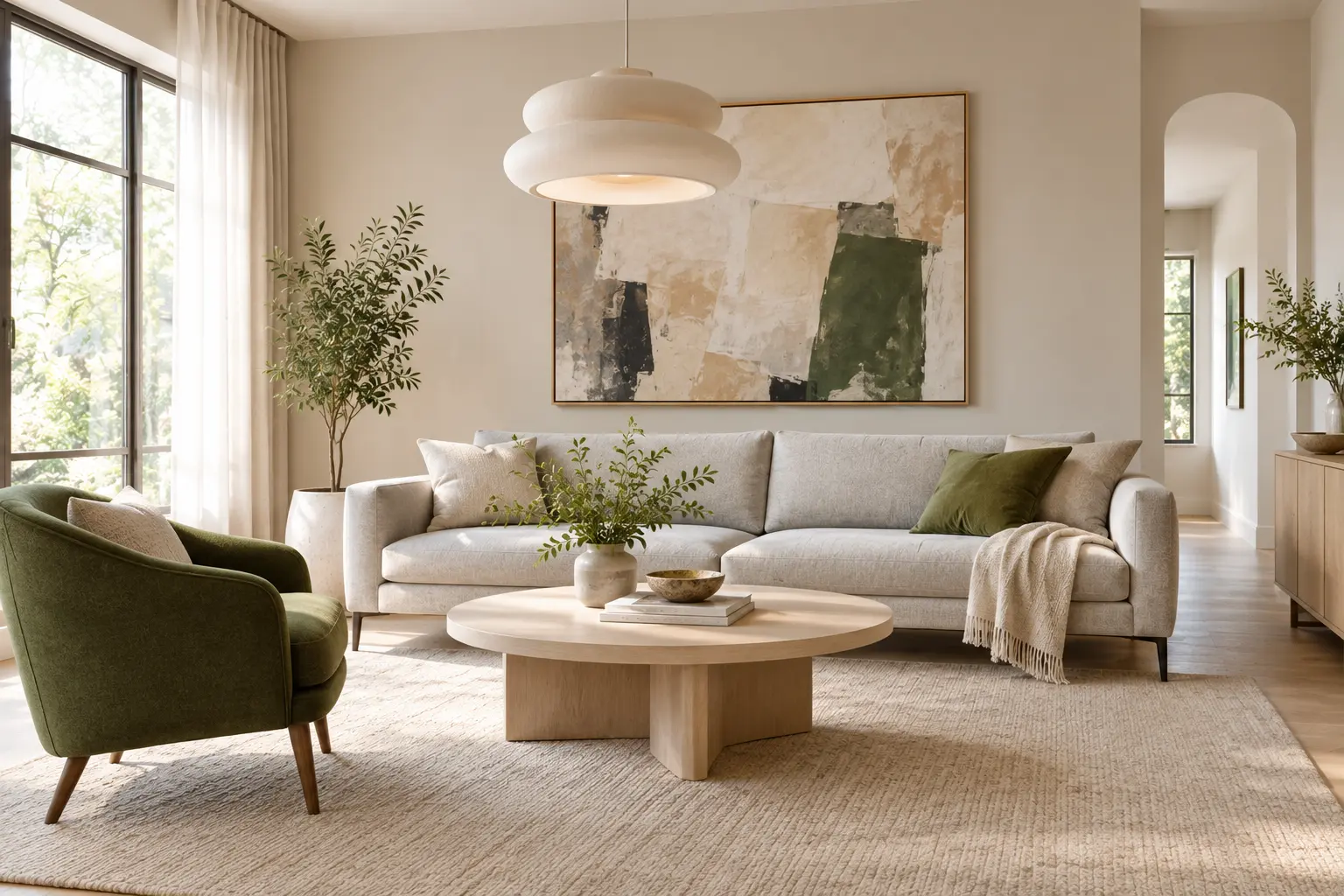
Furniture look at the legs
Open any contemporary furniture photograph and check the bottom. Legs are visible, almost always. No skirts, no slipcovers, nothing upholstered to the floor.
That one detail is hard to fake. A skirted sofa reads “traditional” immediately, no matter what else the room is doing.
Three more checks beyond the legs:
- Low profile. Seats and backs sit lower than traditional furniture.
- Deep seating. Built to sink into, not perch on. If it photographs well and feels like a bench, it’s wrong.
- Hidden storage. A coffee table with a compartment, a bed frame with drawers the storage doesn’t announce itself. For larger solutions, living room storage ideas cover cabinetry designed to stay invisible

Color neutral base, one loud thing
A neutral base across the biggest surfaces walls, floor, sofa and then one saturated accent rather than three timid ones. Red, orange, green, fuchsia, strong blue, delivered through art, cushions, a rug, or a throw.
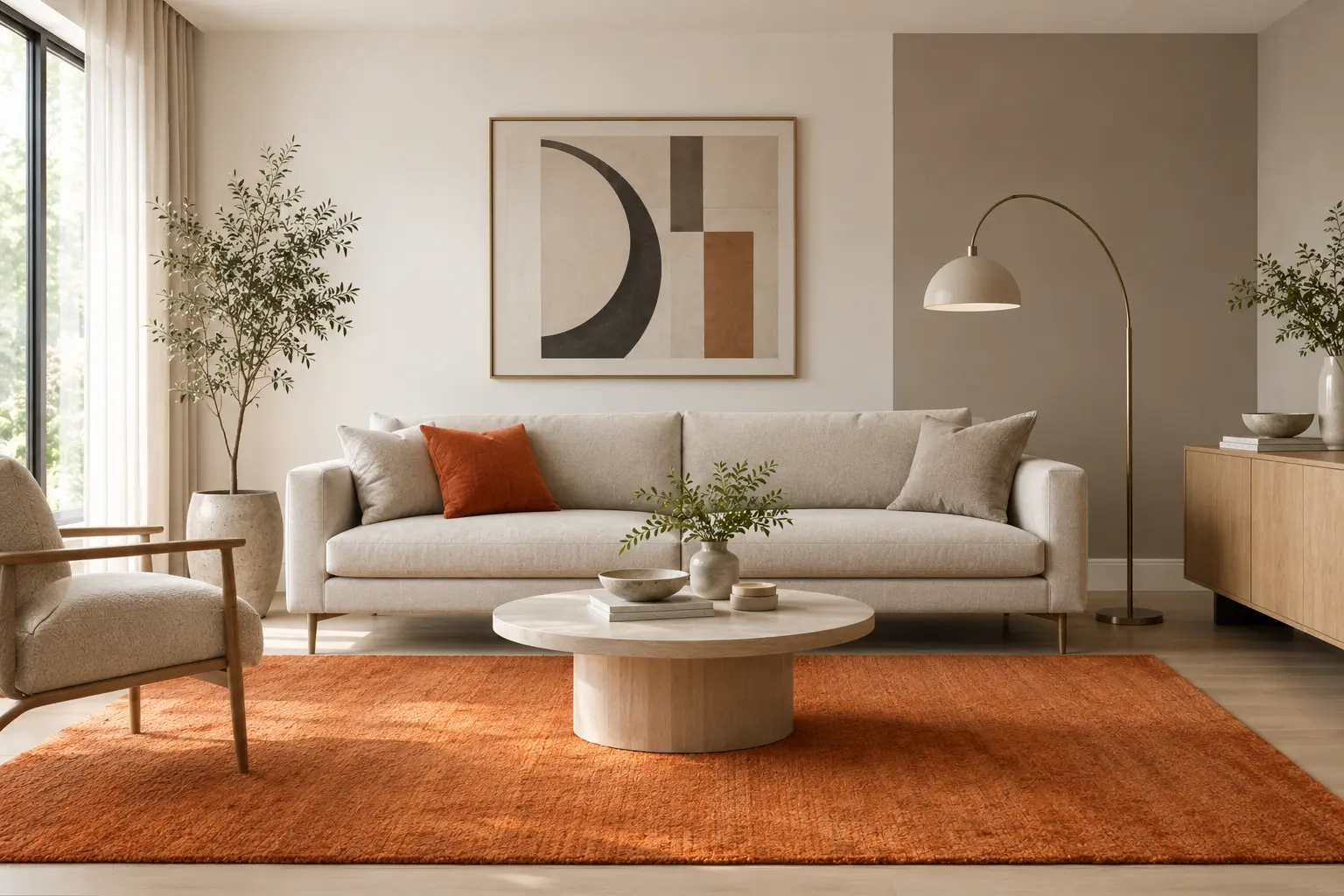
Pattern is the exception. If you use it, keep it geometric and keep it to one element. Layered florals or mixed pattern families fight everything else in the room.
One caveat: plenty of advice says pastels and heavy patterns are avoided in contemporary design. Treat that as a tendency, not a law. A muted pink wall can work. Three competing soft colors with nothing to anchor them can’t. If you’d rather concentrate the accent on one plane instead of scattering it, accent wall ideas are the place to start.
Materials very light or very dark, rarely in between
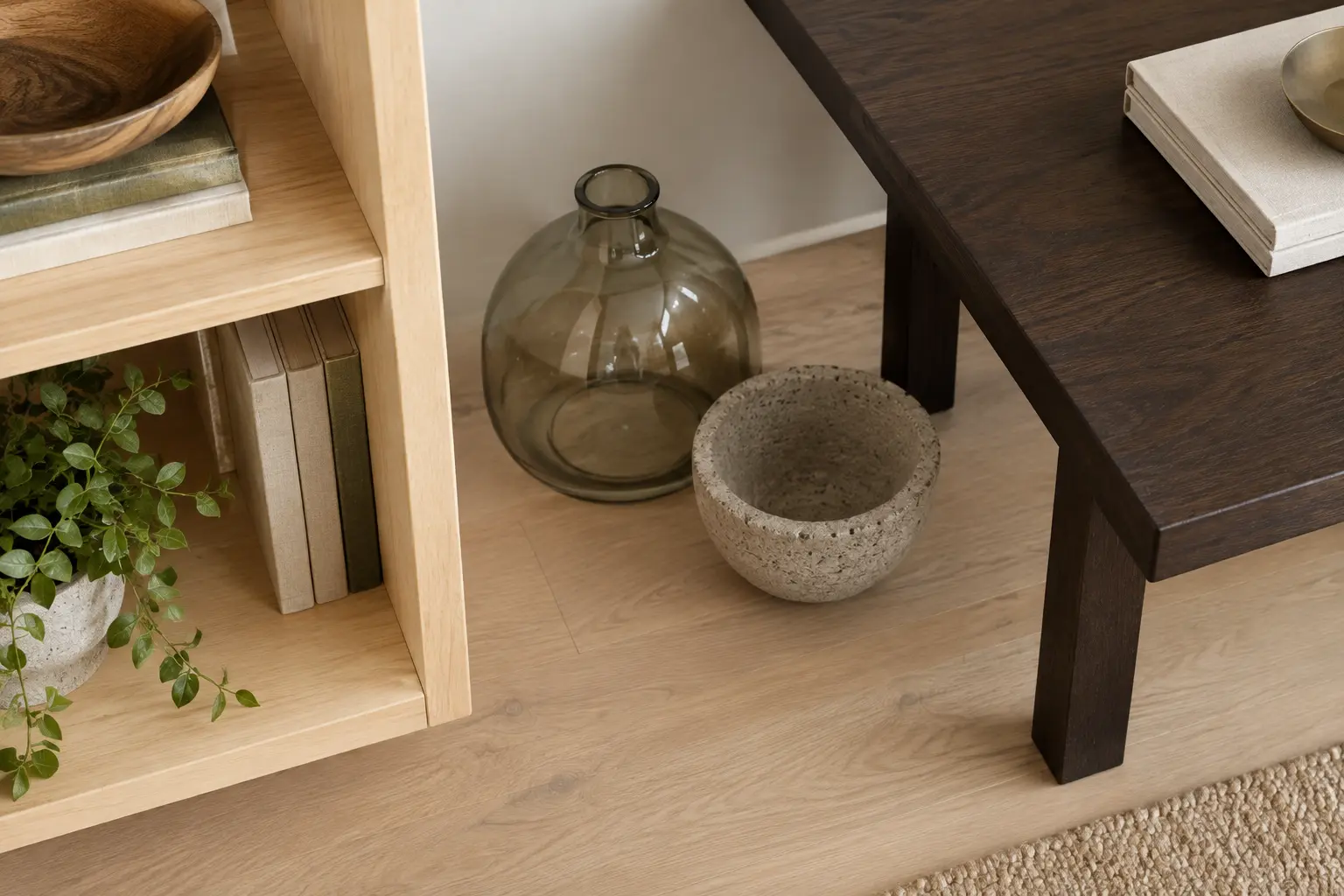
Here’s the rule that separates contemporary timber from traditional timber: contemporary wood tends to be very light pale cedar, birch, maple or very dark, down to espresso. Medium oak is what reads traditional because it’s the default of the previous generation of interiors.
The second move with contemporary interior design materials is contrast. Pair something smooth and reflective glass, steel, chrome, or polished stone against something rough and matter concrete, brick, or raw timber. That tension is what keeps a minimal room from going flat.
For soft furnishings: cotton, linen, wool, silk, leather, boucle. This layer does most of the warmth work.
Decor one object, not five
Edited, not sparse. Sparse means empty; edited means chosen.
In practice: one oversized artwork rather than a gallery wall of small ones, simple frames rather than ornate, and black-and-white photography over busy prints. Geometric wallpaper is fine on one plane, left alone everywhere else.
Objects follow the same logic. One striking piece does more than a shelf of small ones, and the space around it is part of the design. If something isn’t standing out in your room, the fix isn’t more decoration it’s more room.
Plants are the exception to “one object,” and they earn it. Large and sculptural: fiddle-leaf fig, Madagascar dragon tree, something with architecture of its own. A cluster of ordinary houseplants doesn’t read contemporary it reads like a windowsill.
Lighting two layers, one statement
Contemporary lighting is two systems running together. First, quiet and invisible: recessed downlights or track, doing the actual work. Second, one sculptural piece that isn’t there to be efficient an arc lamp, an oversized pendant, a fixture you’d notice switched off.
Avoid swags, tassels, and heavy shades.
And then there’s the light you didn’t install. Windows left bare, or dressed only in sheers, do more than any fixture. If your windows are covered in heavy drapes, change that first it’s free.

The Difference Between Modern and Contemporary Interior Design
Modern refers to a specific historical period roughly the early-to-mid twentieth century, rooted in the Bauhaus and Scandinavian schools. It has a defined vocabulary, and it’s finished. A closed book people keep rereading.
Contemporary is an open book. It borrows from modern minimalism, from traditional design, and from whatever else is in the air.
The cleanest test: a strictly modern room can’t absorb a trend without ceasing to be modern. A contemporary room can absorb almost anything, as long as it’s currently in favor.
Era. Modern: closed period, roughly 1920s–1950s. Contemporary: always the present.
How to tell: designed as a movement, or as a snapshot?
Lines and shapes. Modern: predominantly straight and geometric. Contemporary: straight, with curves now welcome.
How to tell: any soft curves, or is everything squared?
Palette. Modern: warmer, earthier, natural. Contemporary: neutral base with deliberate accents.
How to tell: one loud thing or a quiet unity?
Materials. Modern: industrial plus natural metal, glass, plastic, timber. Contemporary: natural materials with industrial touches.
How to tell: does it feel manufactured or tactile?
Philosophy. Modern: one cohesive theme, then stop. Contemporary: recombine what’s current.
How to tell: would it survive swapping in next year’s pieces?

Contemporary interior design vs. modern: in one line, modern is a period, and contemporary is a moving date.
This is also where contemporary interior design vs. mid-century modern gets muddled. Mid-century is a subset of modern with a fixed signature walnut, tapered legs, organic curves. Contemporary may borrow those pieces, but it doesn’t require them. If your room has walnut and tapered legs plus this year’s textiles and lighting, it’s contemporary using mid-century pieces. That’s a normal thing to do, not a contradiction.
They do share a look, which is why the confusion persists: both are pared back, both want space, both want light, and both show furniture legs. The difference isn’t how they look from across the room. It’s whether the style is bounded by a date.
Can you mix the two?
Yes, and most good contemporary rooms already do. Let modern pieces anchor a mid-century sideboard, a classic lamp shape and use contemporary textiles or lighting for freshness. Unify with one recurring material or color, so the mix reads as a decision rather than a collection.
One detail that surprises people: contemporary can include details that are decidedly un-modern classic moldings, stone counters, traditional hardwood flooring provided they’re part of current taste. That flexibility is the point. It’s what stops contemporary from being “modern lite.
If you’re decorating an older home, the halfway option is transitional traditional warmth with contemporary restraint. Worth a look before you commit to either extreme.
Why Some Contemporary Rooms Feel Cold
Some contemporary rooms genuinely are cold. Sterile, echoey, unwelcoming. The criticism is fair.
But the cause isn’t the style. It’s an execution too much gloss, too many hard surfaces, not enough texture anywhere. Hard floor, flat walls, smooth shiny furniture, nothing soft within reach.
The fix takes a minute to identify and a weekend to implement: add texture. A rug with actual pile. A linen throw. A boucle cushion. Something woven, something wooden, something with visible weave. Flooring is usually the largest hard surface in the room and the hardest to soften if you’re working around bare floors, this guide to living rooms without carpet covers the harder version of that problem.Then check your finishes if everything in the room reflects light the same way, that monotony is the problem.
Let texture do the work color isn’t doing. Quiet palette means interesting materials. Quiet materials means the room has nothing to say.
This connects to a real shift. High-gloss cabinetry and shiny metallics used to signal high-end contemporary; many designers now read them as commercial or dated. Matte and natural finishes took over, along with plaster, fluted timber, zellige tile and hand-worked ceramics. If you’re shopping right now, that’s the single most useful thing to know: change the sheen before you change the color.
The style was never designed to be judged from one angle. The designers who use it well talk about deep seats and rooms people actually sit in. A contemporary room that’s unpleasant to spend an hour in has failed at the actual job, however it photographs.

How to Pull the Look Together, Step by Step
Order matters more than people expect. Wrong sequence is why so many attempts stall halfway.
1. Clear out first. Empty the room of things you don’t love. This is the step people skip and the one that makes the rest possible. You can’t edit around clutter only out of it.
2. Fix the function. Where people sit, where light is needed for reading, where things get put down. Contemporary layout is function-led; get it wrong and no amount of styling rescues it. Give furniture room a sofa jammed against a wall loses the quality that made you buy it. For seating distances, traffic flow and layout patterns, see living room furniture arrangement you buy it.
3. Set the neutral base. Walls, floor, largest upholstery. Warm end or cool end, not the middle of both.
4. Apply the five tests. Legs visible, low and deep seating, one accent color, light-or-dark wood, one statement light.
5. Layer texture. Rugs, throws, cushions, natural materials. This separates a contemporary room from a showroom.
6. Light it in two layers. Practical light plus one piece with presence.
7. Add one thing that’s yours. A piece of art, an object with a story. Contemporary rooms fail when they’re anonymous.
8. Stop. Matters most, and it’s the step people skip. When the room feels calm and slightly empty, you’re probably done. If you’re still buying, you’re not decorating you’re filling space.
On budget: median US renovation spend sits in the low five figures, around $24,000 by the most recent Houzz survey. Most of the steps above cost almost nothing. The expensive items are the ones nobody sees: a settled sofa, decent lighting, one good rug.
6 Mistakes That Make Contemporary Rooms Fall Flat
1. Designing for the photo. Great from the doorway, awkward to sit in. Fix: start from how you use the room.
2. Under-texturing. Hard floor, flat walls, nothing soft. Fix: texture before anything else.
3. All-neutral, no warmth. Reads unfinished rather than restrained. Fix: timber, earth tones, textile.
4. No unifying thread. Polished and rustic pieces that don’t speak. Fix: one recurring material or color.
5. Trend saturation. Busy and slightly chaotic. Fix: two trends that agree, not five that argue.
6. Wrong wood tone. Everything in medium oak. Fix: commit to pale or dark.
The pattern underneath all six: contemporary rooms almost never fail because of a bad object. They fail because of a missing layer. Missing texture, missing warmth, missing editing, missing function. You rarely need to buy the right thing. You usually need to remove something, or add one thing that isn’t furniture.
That also answers the question people search in private why does my contemporary room look cheap? Nearly always gloss, mismatched wood tones and no texture. Rarely the price of anything in it.
Room by Room
The grammar doesn’t change by room. What changes is which element carries the most weight.
Contemporary interior design for the living room
One statement piece, and space around it. That’s the whole method. Pick the sofa, the artwork or the light, give it room, and let everything else support it.
In practice: low-profile seating with visible legs sectional sofas work well here because they hold that low profile across a longer run a rug with genuine texture rather than a flat weave, a neutral base with one accent, one oversized piece of art rather than a grid of small frames. Seating arranged for conversation, not for the camera.
If the room feels unresolved, the answer is usually more empty floor, not more furniture. And if the room has a fireplace, that’s already your focal point don’t build a second one opposite it. In a small living room, low furniture and one large mirror opposite the window will do more than any amount of styling.
Contemporary interior design kitchen
Contrast is the tool matte cabinetry against stone, pale timber against dark, one oversized island rather than several smaller elements. Handleless fronts and integrated appliances do the visual work.
Kitchens are where gloss did the most damage, so this is the room where changing the finish has the biggest effect. If you’re changing one thing, change the sheen.

Contemporary bedroom
Restraint plus texture. Low bed, simple frame, no heavy valance, one textured layer a boucle throw, a linen headboard and lighting you can dim.
Bedrooms are where the cold critique lands hardest, so warmth matters most here: softer textiles, warmer neutrals, nothing shiny. Keep the palette to two or three tones and let the textiles vary instead.
Renting, or Working With a Small Space
Most of what you read about this style assumes you can open up a wall or install custom built-ins. Most people can’t. The style is more portable than it looks, because most of what defines it isn’t structural.
- Lighting does the heaviest lifting and is the most reversible. A plug-in arc lamp or a strong floor lamp changes a room more than paint. No electrician, no permission.
- Storage lives in the furniture. A coffee table with a compartment, an ottoman that opens, a bed frame with drawers. Built-in storage is a bonus; furniture storage is the renter’s version.
- Slatted panels lean; they don’t get installed. A timber slat panel against a wall gives you the warmth of built-ins and moves with you.
- Accent walls can peel off. Removable wallpaper or one well-chosen paint plane, no deposit conversation.
- Mirrors buy light. One large mirror opposite the window does more for a small apartment than decluttering three rooms.

- Keep the profile low. For layouts that work in a tight footprint, apartment living room themes goes further on arranging around one window and a shared wall.
The mistake to avoid is buying for the space you wish you had: the oversized sectional that eats the room, the dining table for eight in an apartment that seats two. Contemporary in a small space means fewer, better, lower.
Does Contemporary Interior Design Date Quickly?
Yes and no, at different levels.
Individual pieces date. The chrome-framed glass coffee table, the finish that was on every surface a few seasons ago, the trend color of a given year. Those have a shelf life, and pretending otherwise would be dishonest.
The grammar doesn’t. Clean lines, functional layouts, deliberate space and restraint have been the constant through several complete turnovers of what sits on top of them.
So the deal is this: it stays contemporary through refreshing, not through freezing. Live with it long enough and it stops being current that’s the trade for the freshness you got at the start. Some people enjoy re-editing every few years. Others want to choose once and be finished, and for them modern or transitional will serve better.
Reassuring part: a home built decades ago can still be contemporary if it’s been refreshed thoughtfully. The style isn’t a purchase date. It’s an ongoing relationship with what’s current.
Questions People Actually Ask
What is contemporary interior design style, exactly?
The current iteration of a long-running approach: clean lines, functional layouts, restraint, dressed with whatever is in taste this year. The approach is stable; the dressing isn’t.
What is modern style interior design, and how is it different?
Modern is a fixed historical period with defined materials and shapes Bauhaus roots, mid-century signature pieces, earthier palettes. Contemporary is the moving present. A modern room can’t absorb a trend; a contemporary room is built from them.
Is contemporary the same as minimalist?
No. Minimalism is a discipline of having as little as possible. Contemporary uses restraint but allows layered texture, warm color and a considered amount of decor. Simplified, not stripped.
What furniture actually defines a contemporary room?
A low-profile sofa with exposed legs and a deep seat, a simple wood or stone table, understated geometric lighting, and storage that hides itself. Get those four right and the rest follows.
What colors should I use?
A neutral base across walls, floor and largest upholstery, then one saturated accent rather than several soft ones. Warm neutrals and earth tones are the current direction; cool white and gray still work but need more texture to feel livable.
Can I mix modern and contemporary pieces in one room?
Yes. Let modern pieces anchor and use contemporary textiles or lighting for freshness. Unify with one recurring material or color so the mix reads as a decision.
Why does my contemporary room look cheap?
Gloss finishes, mismatched wood tones, no texture. Rarely the price of the furniture. Fix those three and a modest room reads expensive.
You can take this a long way on your own. Clearing, layout, palette and texture are decisions you’re qualified to make in your own home. Where it’s worth paying someone is lighting design, and any room where the architecture fights you: awkward proportions, poor natural light, an older home you don’t want to modernize into blandness.
If you only do three things: clear the room out, check that your furniture legs are visible, and add texture until the cold feeling goes.
Those are the contemporary interior design ideas worth acting on tonight none of them cost anything, and all of them change the room. If you want the wider picture, all the interior design styles puts contemporary next to modern, traditional, transitional and the rest, so you can see what it’s actually being compared to.

Pingback: Neutral Color Palette Interior Design: 7 Simple Room Combos
Pingback: What Is Traditional Interior Design? A Clear Guide
Pingback: Best Materials for Industrial House Interiors: 12 Picks
Pingback: Yellow Bedroom Ideas: 15 Easy Looks That Feel Calm and Warm