
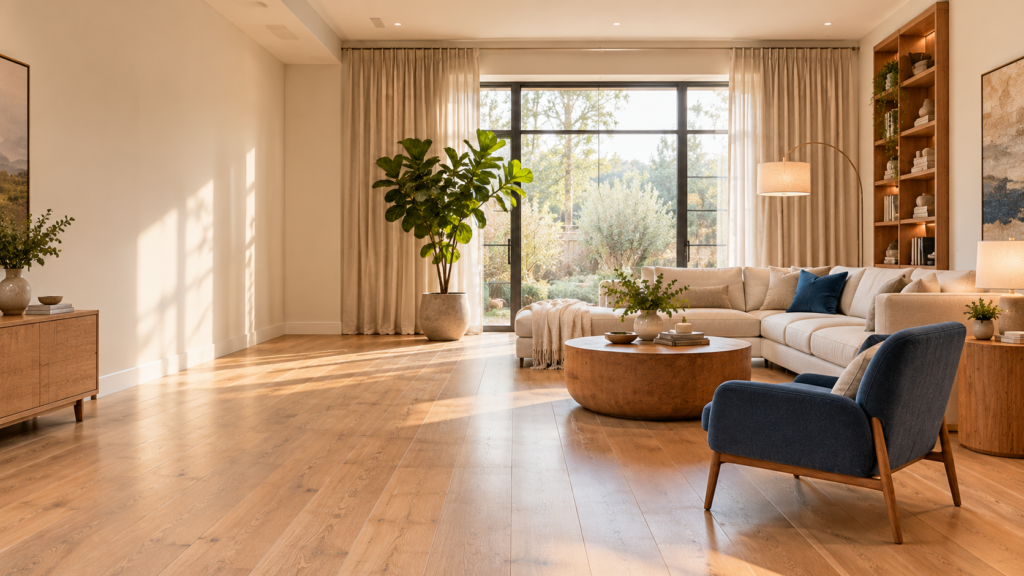

Why a Living Room Without Carpet Is the Smarter Choice for Modern Homes
Yes, choosing a living room without carpet is a smart, deliberate move. The term just means the hard floor is the finished look, with no wall-to-wall textile hiding it and no rug piled on top. I made the switch in my own home and the difference showed up within days.
Cleaning is the first thing you notice. Spills wipe up in seconds. Dust gets swept away instead of sinking into fibers where it sits for years.
And with kids or dogs in the house, that is the whole game. Spills happen daily. Nobody wants to steam clean the living room every weekend just to keep it decent, and pet friendly living room floors are the reason I see more families pulling the carpet out now than ever before.
The floor itself becomes part of the design. Hardwood grain, polished concrete, warm tile with neat grout lines. Modern floorplans lean on unbroken flooring from room to room, and a big rug has always been a way to hide the floor. Take the carpet away and the surface you paid for finally shows off. The design world noticed too. Editors at publications like House Beautiful and Architectural Digest now treat bare floors as a finished look, not a room waiting for one.
But bare floors come with two problems almost nobody warns you about before the renovation. Cold feet in winter. And a hollow echo that turns a normal conversation into noise.
Both are fixable. That matters, because both are the reason homeowners talk about removing wall-to-wall carpet and then stall before the first staple comes out. The decision is easy. The two problems waiting after it are what stop people.
The allergy story deserves a straight answer as well. Hypoallergenic living room flooring is one of the real carpet-free home benefits, since a room without carpet holds far less dust mite habitat. But bare floors are not an instant cure for sneezing. The moment you walk across a hard floor, fine dust lifts back into the air before any vacuum sees it, which is why filtration and damp cleaning matter once the carpet is gone.
So is it acceptable to have a living room without carpet? More than acceptable. The whole direction of home design now is toward open, uncluttered floors with softness added above the floor line instead of on it. Which is exactly where most people get stuck. Not on the decision to remove the carpet, but on what to do in the first weekend after it is gone.
- Why a Living Room Without Carpet Is the Smarter Choice for Modern Homes
- Why Cold Hard Floors in Living Room Spaces Happen (And How to Warm Them Up)
- 7 Smart Ways to Make a Living Room Without Carpet Feel Cozy
- How to Reduce Echo in a Living Room Without Carpet (The Part Everyone Skips)
- The Furniture Mistakes That Ruin Bare-Floor Rooms (And the Layouts That Work)
- Styling by Surface: Hardwood, Laminate, Tile, and Concrete Floors Without Carpet
- Keeping Bare Floors Clean, Quiet, and Actually Healthier
- The 5 Carpet-Free Mistakes to Avoid (And Your Weekend Action Plan)
- Frequently Asked Questions
Why Cold Hard Floors in Living Room Spaces Happen (And How to Warm Them Up)
A living room without carpet feels icy for one reason, and it is not the thermostat. The floor pulls heat from your feet faster than your body replaces it, even at a comfortable 72 degrees Fahrenheit, around 22 degrees Celsius.
Why the Thermostat Can Lie: Contact Heat vs. Room Air Temperature
I have watched people raise the heat twice in one evening and still shuffle around in thick socks. The air gets warm. The floor does not care.
Thermal conductivity decides how a floor feels underfoot. Some materials pull heat from your feet on contact and others barely take any. Tile, stone, polished concrete, and dense hardwood are the fast ones. Softer woods like pine, cedar, and cork feel warmer at the very same room temperature.
And the air is not helping. Warm air rises, so the first foot or two above the floor can sit cooler than the air at head height. Ask any parent whose kids play on tile, because the contact layer is what children actually feel.
Hard floors are not always cold. That myth dies the moment you compare bare feet on pine boards with bare feet on tile. And it is why a cold hard floor in a living room sends people hunting for the thermostat in the first place. That dial never fixes a conductivity problem.
Subfloor Fixes, Radiant Heat, and Warm-Foot Swaps That Actually Work
So how do you keep feet warm on hard floors without rugs? You warm the contact, not the room.
A thermal break is a layer beneath the finished floor that slows heat escaping into the slab. A good one can raise the surface temperature by as much as 7 degrees Celsius, about 14 degrees Fahrenheit. Skipping that layer during a carpet removal renovation is the mistake I hear regretted most.
Radiant floor heating mats go under the spots where feet actually land, like the edge of the sofa. A full radiant heating system costs more, but during a renovation it ends the problem for good.
For drafty bare floors the small moves stack up. Floor draft stoppers at exterior doors. Heavy curtains across glass doors. House shoes with a real sole.
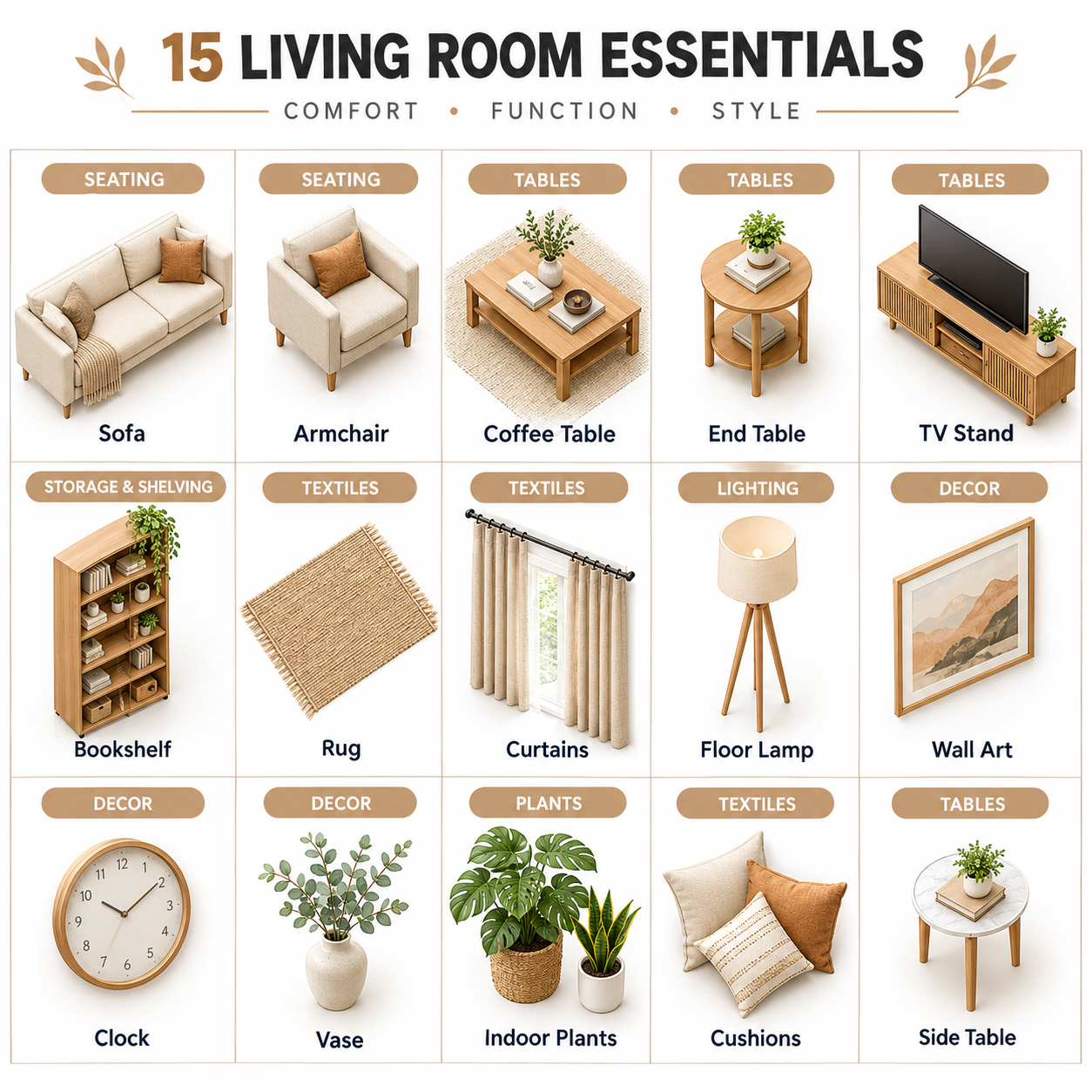
And remember why rugs existed. They gave children a warm patch to sit on cold tile. Two or three large floor cushions recreate that warmth without covering your floors. The default advice is still to buy a rug. It is not the only fix.
7 Smart Ways to Make a Living Room Without Carpet Feel Cozy
You make a living room without carpet feel warm and inviting by moving the warmth off the floor and into the fabrics, light, and shapes around it. I call this edited warmth. The idea that coziness requires covering the floor is the biggest myth in this whole topic. Warmth is a whole room sensory equation, and every way to make a living room cozy without carpet comes back to that.

1. Swap Cold Fabrics for Deep, Touchable Upholstery
The first thing I swap is the sofa fabric. Plush velvet upholstery, bouclé, and chenille invite touch and quietly absorb sound, the job bare floors stopped doing. Dense weaves matter more than fancy labels, or at least more than the price tag implies. These soft furnishings for bare floors do the real work. Slick leather and flat synthetics only bounce noise around.
2. Let the Curtains Pool: Floor-to-Ceiling Drapery Done Right
Get the curtains off that sad halfway position. Hang the rod just below the ceiling and wider than the window frame, then let heavy linen or thermal weaves puddle slightly on the bare floor. That soft edge against hard flooring changes the whole feel. And matching curtain color to the sofa ties the room together. Layered textiles like these do more than any floor covering.
3. Light the Room in Layers at Three Heights
Most people throw pillows at the problem and leave one cold white bulb overhead. The room stays hollow. Cozy living room lighting ideas all start the same way. Start with warm 2700K bulbs at three heights. A reading lamp by the sofa, a table lamp at elbow height, and a dimmable overhead for actual tasks. Mushroom and ambient floor lamps bring the low evening glow that overheads never give you.
4. Put Weight in the Center: Statement Coffee Tables and Ottomans
The center of the room needs gravity. Designers agree one substantial anchor piece takes over the visual job of a rug, and a thick wood coffee table or big upholstered ottoman does exactly that. Of all living room without rug ideas, this is the one I never skip. Round floor cushions and poufs nearby keep the middle soft. Skip glass tops. Glass on bare floors adds glare and noise, not warmth.
5. Bring in Living Texture: Plants, Branches, and Biophilic Shapes
Hard floors are all straight lines. Plants break them. One large fiddle leaf fig or palm in the corner, or a vase of tall branches on the table, softens every rigid edge in the room. Houseplants work on bare floors for one reason. The organic shapes answer the geometry problem that rugs used to solve.
6. Choose Warm Wood Tones and Natural Grain Wherever You Can
Cone shaped wooden legs beat metal legs every time in a bare floor room. Warm wood tones like walnut and oak visually heat the space, and natural wood grain gives the eye something rich to rest on. I picked wood legs over trendy gold metal once and I still think that was the right call. Wood also stays quieter when furniture shifts on hard flooring.
7. Soften the Vertical Plane: Wall Hangings, Shelves, and Acoustic Art
Walls are the forgotten half of coziness. Fill them with bookshelves loaded with real books, textile wall hangings, and fluted wood slats. Fluted slats and acoustic wall art for living room walls do double duty, softening sound and sightlines together. Treat the walls like soft surfaces and the room stops feeling like an echoey box before you even touch the floor.
How to Reduce Echo in a Living Room Without Carpet (The Part Everyone Skips)
You reduce echo in a living room without carpet by treating the walls and the soft goods instead of the floor. Rugs used to absorb ambient noise for free. Once they come out, that job moves to everything else in the room.
Why Bare Floors Make Rooms Sound Like Cafeterias
Nobody notices the echo until the first phone call from the middle of the room. Hard floors act like mirrors for sound. They bounce back over 95 percent of the sound energy that lands on them instead of soaking it up like carpet fibers. That reflected energy lingers, and acoustic engineers measure how long it stays as reverberation time.
Removing carpet can stretch that lingering sound by roughly a third to a half of a second in a normal living room. Small numbers. Big effect. Those extra fractions are why TV dialogue smears together and why your voice feels tired after an hour of talking. Phone calls on speaker are worse. The caller hears the room twice.
And the size myth needs retiring. Echo is an absorption problem, not a square footage problem. A small room full of hard surfaces rings louder than a large room full of soft ones. Room acoustics and echo come down to what the surfaces do with sound, not how much air the room holds.
The 20 to 30 Percent Wall Rule: Curtains, Slats, Shelves, and Acoustic Art
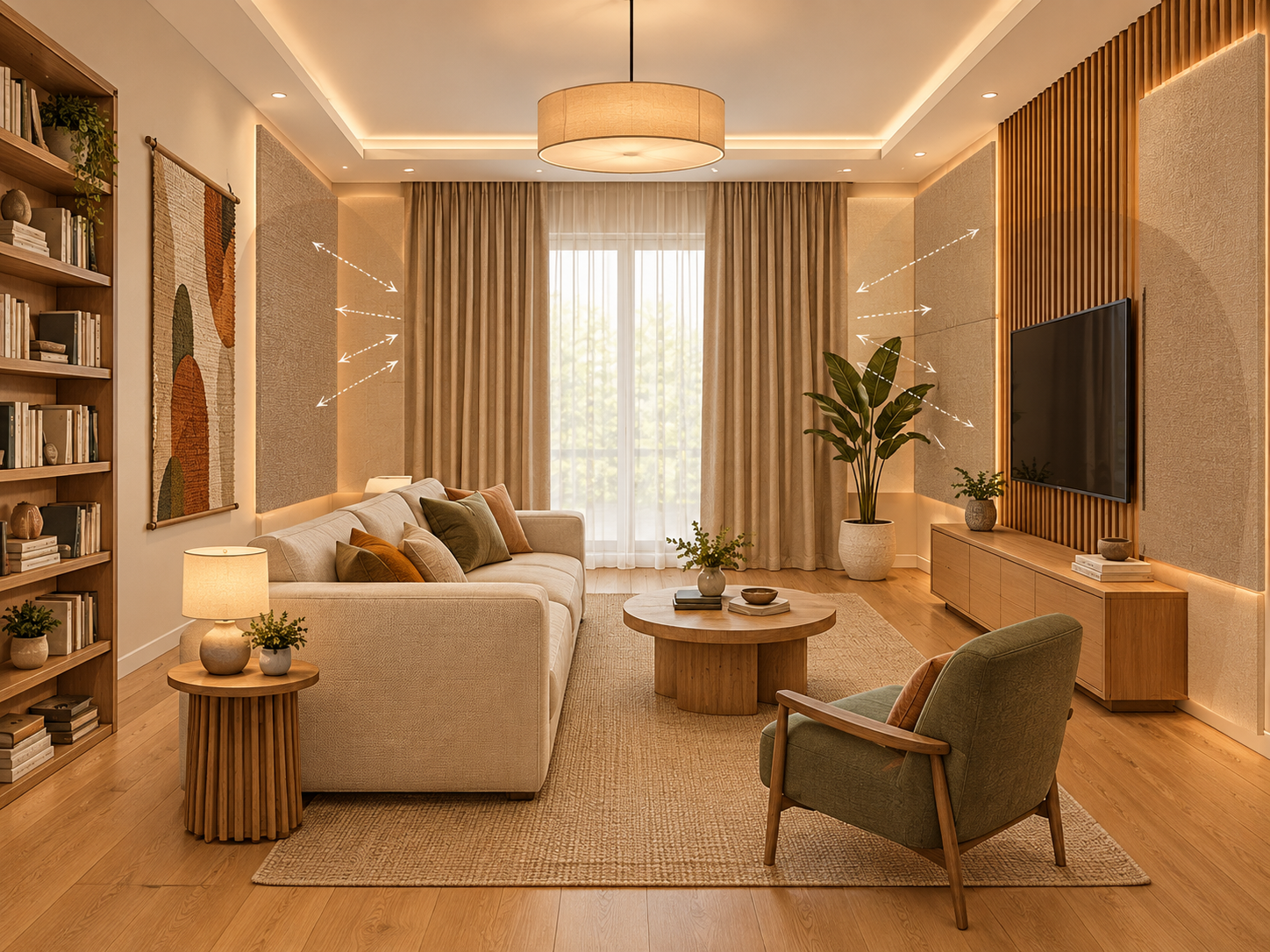
Treat 20 to 30 percent of your wall surface with something soft or textured and the echo usually drops to a livable level, for less money than most people expect. That is the whole rule.
The spots that matter most are first reflection points. Clap once while sitting in your usual seat and listen for the first hard surfaces that throw the clap back, usually the side walls. Hang acoustic wall art for living room walls there first.
Skip the cheap foam squares. Acoustic foam only tames high frequencies, so the room still booms underneath. Fabrics absorb. Bookshelves and fluted slats scatter. Heavy velvet and layered curtains do double duty as decor and sound control.
Cheapest first. Heavy curtains, fabric wall hangings, loaded bookshelves, acoustic wall art, then fluted wood slat panels that designers now treat as wall decor rather than studio gear. And a book filled shelf is one of the best broadband diffusers a home can get. Free acoustics disguised as decor.
Guidance standards for homes, like the WELL building standard and BS 8233, aim living spaces at short reverberation times for this exact reason. Most guides tell you to buy a rug. Your walls were the answer the whole time.
The Furniture Mistakes That Ruin Bare-Floor Rooms (And the Layouts That Work)
Every bare floor room that feels off has the same root cause, and it is never the floor. Oversized block furniture tries to do the rug’s job and fails. In a living room without carpet the layout itself has to anchor the space.
The L-Shaped Sectional Trap: Why Bulky Sofas Kill Bare-Floor Rooms
I fell for the showroom illusion myself. A sectional that looked manageable under showroom lights swallowed half the room the day it arrived. Furniture in a showroom sits in a huge empty space, so your eye gets no honest scale to judge against.
And this is exactly where L shaped sectionals hurt bare floor rooms. The dead corner seat nobody can reach. The bulky back that traps dust and ruins your vacuum routine. The whole block parked in front of the window, eating natural light and hiding the curtains behind it. Heavy, immovable, and miserable to clean behind.
Foot traffic has nowhere to go. You shuffle around the furniture instead of through the room.
The fix before you buy is embarrassingly cheap. Masking tape. Mark the sofa footprint on the floor and live with the outline for two days. Walk the routes you actually walk. If the tape eats the room, the furniture will too. Keep real margins at the walls as well, because a sofa shoved tight to the wall makes any room feel smaller than the tape says. This one habit separates minimalist living room design that breathes from rooms that feel stuffed.
The Bare-Floor Layout Formula: Anchor, Angle, Elevate
Good layouts on bare floors follow three moves. Anchor, angle, elevate.

Anchor. Give the middle gravity. A thick wood table, a big ottoman, a cluster of round cubes. Without that weight the seating floats like islands, the complaint I hear most about rooms without rugs. The best area rug alternatives start with furniture, not floor coverings. Of all the ways to anchor a room without a rug, this is the least glamorous and the fastest to work.
Angle. Turn the chairs toward each other and the sofa. Two angled seats create a conversation zone the eye reads as one group, no rug needed. Curved seating pulls a grouping together even tighter. I swapped a heavy sectional for a curved velvet set with two matching chairs and a light two seater opposite, and the room opened up overnight.
Elevate. Put everything on real legs, five to seven inches of clearance. Elevated legs make hard floors look bigger because light and sightlines run underneath. Designers lean on this trick constantly.
And do not skip furniture felt pads. Felt gliders under every leg keep daily sweeping quiet, protect the finish along busy walking paths, and let you slide the sofa to clean behind it in seconds. Buy for the room you have, not the showroom you walked through.
Styling by Surface: Hardwood, Laminate, Tile, and Concrete Floors Without Carpet
People copy cozy setups out of photos and wonder why their room still feels cold. The missing variable is usually the floor. Hardwood, laminate, luxury vinyl plank, tile, and polished concrete each need a different playbook in a living room without carpet.
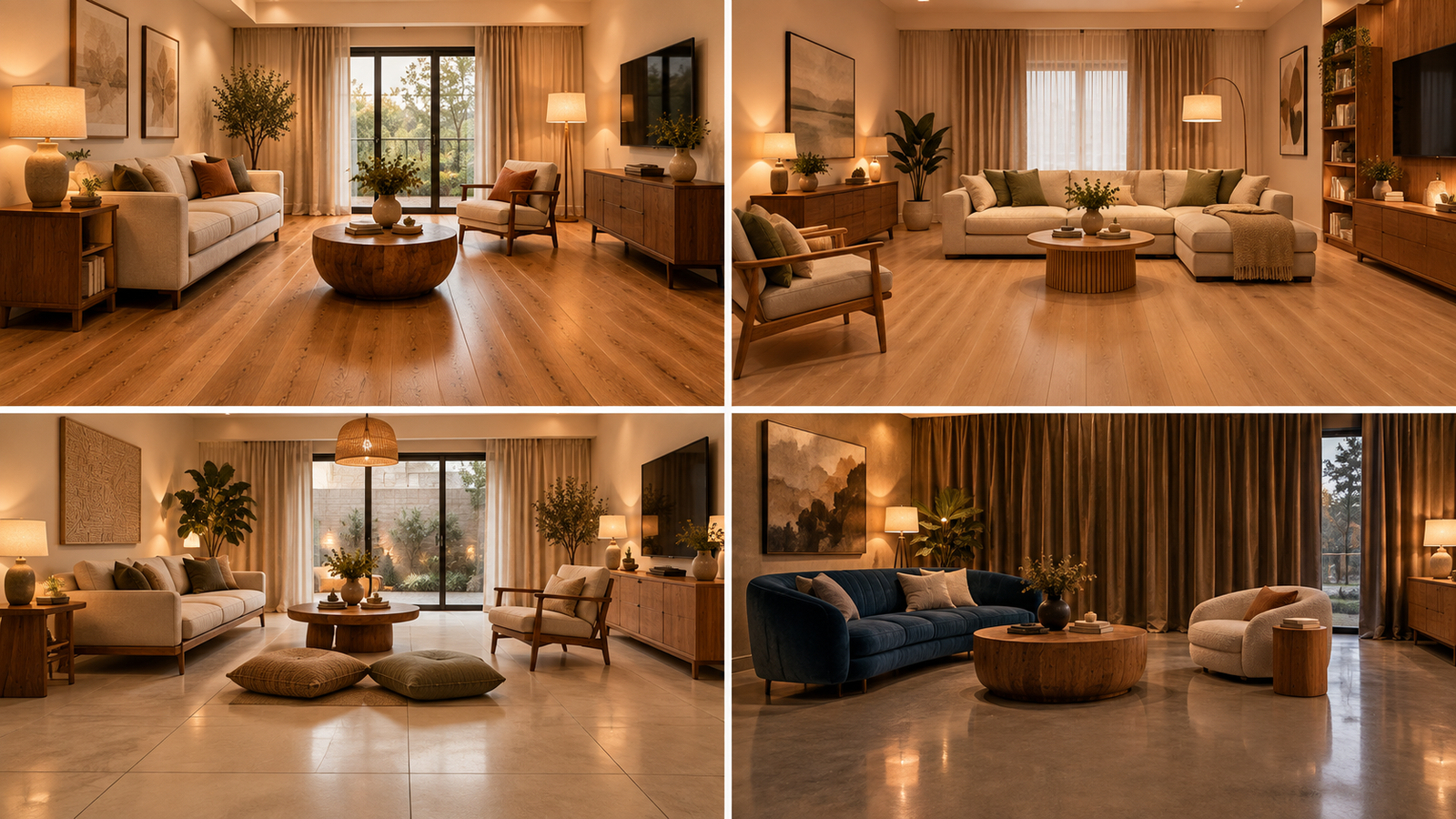
| Surface | Warmth Underfoot | Noise | Care | Best Styling Move |
|---|---|---|---|---|
| Hardwood | Warm to mild, species dependent | Low to moderate | Sweep often, damp mop, felt pads | Let the grain show, keep big blocks off the center |
| Laminate | Mild, warmer with thermal underlay | Hollow click | Dry dust, damp mop, no soaking | Kill the sheen with matte textures and warm lamps |
| Luxury Vinyl Plank | Mild to warm, attached backing helps | Soft underfoot | Waterproof, simple damp mop | Treat it like wood: warm tones, layered textiles |
| Tile | Cold | Loud, echo prone | Damp mop, grout care | Warm contact points at the sofa, vertical textiles |
| Polished Concrete | Cold, sealer adds slight buffer | Loudest | Damp mop, reseal now and then | Velvet, heavy curtains, intentional industrial look |
Hardwood: Let the Grain Be the Artwork
Hardwood is the easiest surface to live with and the easiest to smother with styling. Let the natural wood grain stay visible and pull dark furniture blocks off the center so natural light reflection reaches the floor. A bright warm floor does more for coziness than any accessory.
Warm oak and honey tones are where rugless interiors keep heading. Plain floors carry bolder textiles above, patterned parquet needs restraint. Felt pads under every leg or the finish scars within a season. And the surprise about barefoot warmth. Species density decides the chill, not the color. Pale pine can feel warmer than dark walnut.
Laminate: The Budget Surface That Still Deserves Good Styling
Laminate gets written off as the cheap option, but a laminate flooring living room can look warm with the right moves. Start with the palette. Warm oak and honey laminates beat cool gray planks for coziness, since gray drifts cold the longer you live with it.
Then kill the sheen. Cheap laminate shines like an office lobby. Matte accessories, soft textiles, and warm lamps pull the eye away from the glare. And if the floor still feels cold, a thermal underlay beneath floating planks is the fix more people should check before they accept the chill.
Luxury Vinyl Plank: The Warm Middle Ground
If tile is the coldest option and hardwood is the priciest, luxury vinyl plank sits in the useful middle. A rigid core with an attached foam or cork backing takes the edge off the chill, and the whole surface stays softer underfoot than stone or ceramic. Pet accidents and spills wipe up without drama, which is why this is the surface I mention first to busy families.
What to check before buying is short. Wear layer thickness for scratch resistance. An attached underlayment for warmth and quiet. Click lock edges if you want a floating floor over what you already have. And bring samples home before you commit. Leave them on the floor for two days, because warehouse light lies about color and texture the same way showroom light lies about scale. If low impact materials matter to you, cork and linoleum are the eco friendly flooring alternatives worth pricing against vinyl.
Tile and Concrete: Softening the Coldest Surfaces
Tile and polished concrete are the coldest surfaces in the book and the most rewarding to soften. Tile floor living room styling starts at the grout lines. Those thin channels leak cold and collect grit, so give feet warm contact points to land on. Radiant mats under the sofa area fix the thermal comfort problem where it actually lives, and warm wood legs keep feet off the worst of the cold.
Then stack the room vertically. Heavy textiles above eye level, thick curtains, wall hangings. Polished concrete and terrazzo work as an intentional look, not a compromise. Just remember why rugs existed. Warm contact for bare feet and soft spots for children on cold tiles. Floor cushions give that back.
Keeping Bare Floors Clean, Quiet, and Actually Healthier
Everyone expects bare floors to be less work, and they are. What surprises people is the dust. Is it healthier to not have carpet? Mostly yes, with one honest caveat nobody mentions. The allergy case starts by removing the biggest dust reservoir in the house. But the health win only completes with two habits.
Here is what most guides skip. Carpet fibers trap dust. Bare floors release it. Walk across a hard floor and fine particles lift back into the breathing zone before any vacuum sees them. So going no carpet in the house does not automatically end the sneezing. If dust mite allergies pushed you to pull the carpet, know that clinical reviews of respiratory changes after carpet removal have not settled the question either. Temper the expectations.
Hard floor maintenance and cleaning comes down to cadence and capture, not elbow grease. Damp mop instead of dry sweeping, because dry sweeping launches settled dust right back to nose level. And run a HEPA air purifier in the room. HEPA capture turns bare floor hygiene into an actual plan.
Pet-friendly floors earn that name fast. In a living room without carpet, pet hair wipes up instead of weaving into fibers, and most robot vacuums handle bare floors far better than thick pile. The robot vacuum alone converts people. Just keep soft goods low trap. Short pile, tight weaves, upholstery you can shake clean in a minute. And keep seating light enough to move so every corner gets cleaned often, not twice a year.
Most people expect bare floors to do the health work for them. The floors just make the work possible.
The 5 Carpet-Free Mistakes to Avoid (And Your Weekend Action Plan)
Every bare floor room that disappointed its owner failed the same short list of ways. Where do I start this weekend? With the layout, not the shopping cart.
Here are the five, ranked by how much damage they do.
One. Ignoring the echo. That hollow ring is the number one regret, and it never fixes itself.
Two. Ignoring the chill. Cold floors push people back to wall-to-wall faster than anything else.
Three. Bulky furniture. Oversized blocks trap dust, block light, and make cleaning a wrestling match.
Four. Cold white lighting. One overhead bulb on bare floors turns a living room into an office lobby.
Five. Dry sweeping. It launches the dust you just settled back into the air you breathe.
And the mistake behind the mistakes. Trying to fix all five at once. The order matters more than the budget.
| Day | Focus | The Moves |
|---|---|---|
| Day 1 | Layout | Tape the footprints, anchor the middle, angle the chairs, elevate the legs |
| Day 2 | Warmth and light | Textiles up, warm 2700K bulbs in, curtains pooled |
| Day 3 | Acoustics | Treat the walls until the room stops ringing |
The weekend plan is just sequencing. Day one, layout. Tape the footprints, anchor the middle, angle the chairs, elevate the legs. Day two, warmth and light. Textiles up, warm bulbs in, curtains pooled. Day three, acoustics. Treat the walls until the room stops ringing.
Most homeowners who talk about wall-to-wall carpet removal never actually finish the job. Fear of exactly these problems is what stops them. But a living room without carpet rewards the people who sequence instead of panic. Fix the layout first, then the warmth, then the sound. Buy furniture that fits your real room and your real life, not whatever is trending this year. Decide what you want the room to be before you spend anything.
Frequently Asked Questions
Can you have a living room without carpet or a rug?
Yes, and more designers treat it as a deliberate choice every year. Bare floors show off good flooring and clean faster than any textile ever will. The catch is warmth and sound. Compensate with thick upholstery, pooled curtains, layered light, and one solid anchor table. That is the whole trade.
How do I make my living room cozy without carpet?
Stack the softness above the floor line. Deep upholstery you want to touch, curtains that puddle slightly, warm 2700K lamps at three heights, a big plant or two, and a substantial coffee table or ottoman anchoring the middle. That combination does everything a rug used to do, minus the cleaning.
Why does my living room echo now that I removed the carpet?
Because hard floors act like mirrors for sound. Bare surfaces bounce back nearly all the sound energy that carpet fibers used to absorb, and the ringing builds up fast. Treat 20 to 30 percent of your wall area with curtains, acoustic art, loaded shelves, or slat panels and the echo drops back to comfortable.
What can I put on the floor instead of a rug?
Nothing, if you do not want to. The floor can stay completely bare. If you still want a visual anchor, use a tight furniture grouping, a washable play mat in a kid zone, or a slim decorative mat near the entry. Those give you the zoning effect without covering the floor.
Will my kids or pets be uncomfortable on bare floors?
Less than you fear, and cleanup gets easier. Kids love a couple of big floor cushions for play zones, and house slippers handle winter mornings. After pet accidents, a bare floor cleans up in minutes instead of holding stains and odors the way carpet piles do. Warmth is manageable. Messes are not.
Do I need to refinish or change my flooring after removing the carpet?
Usually something, yes. After wall-to-wall carpet removal, expect staple holes, tack strip marks, and lighter patches where the carpet blocked sun and wear. Some floors clean up fine. Others need sanding and refinishing, or a fresh floating floor on top. Budget for transition thresholds at doorways too. Inspect the subfloor before planning the styling.
Is carpet still popular in living rooms?
Wall-to-wall carpet still owns plenty of bedrooms and colder climates. But in living rooms the direction has moved toward hard surfaces with softness layered above them. Honestly the two are converging. Carpeted rooms add hard-surface rugs, and bare-floor rooms add the soft goods carpet used to handle.

Pingback: Ideas for Computer Desk in Living Room: 10 Smart Setups
Pingback: Living Room Theme Ideas for Apartments: 8 Easy, Cozy Looks
Pingback: Family Room vs Living Room: 7 Clear, Practical Differences
Pingback: Ranch Style House Interior Design: Modern Ideas That Work
Pingback: Interior Design Styles Explained: 12 Smart Choices
Pingback: Contemporary Interior Design: What It Is and How to Use It
Pingback: DIY Room Decor for Small Apartments: 10 Space-Saving Ideas
Pingback: Neutral Color Palette Interior Design: 7 Simple Room Combos
Порносайты полезны в качестве доступный формат найти взрослый материал без лишних поездок и лишнего стресса.
Подобные ресурсы лесби студентов без регистрации предоставляют анонимный доступ к разным материалам и помогают человеку самостоятельно определять подходящий сценарий досуга.
Для совершеннолетних пользователей подобный сервис понятная опция отвлечься дома и не переходить чужие границы.
Стоит помнить, что такие сайты рассчитаны лишь для 18+ и обязаны соблюдать требования закона и добровольного решения.
Pingback: Best Materials for Industrial House Interiors: 12 Picks